

When purchasing a home EV charger, many buyers focus on charging power, smart features, and installation costs. However, one decision often has a greater impact on day-to-day convenience: choosing between a tethered and an untethered wallbox.
Both options can deliver the same charging performance. Whether you install a wallbox 7.2 kw, a 7.2 kw ac charger, or a more advanced smart charging system, the difference lies not in charging speed but in usability, flexibility, maintenance, and long-term ownership experience.
For most private homeowners who charge the same vehicle every day, a tethered charger offers maximum convenience. For multi-vehicle households, public installations, and future-proofing considerations, an untethered charger may provide greater flexibility.
This guide explains the key differences, practical trade-offs, and purchasing considerations to help you select the right charging solution.
What Is a Tethered EV Wallbox?
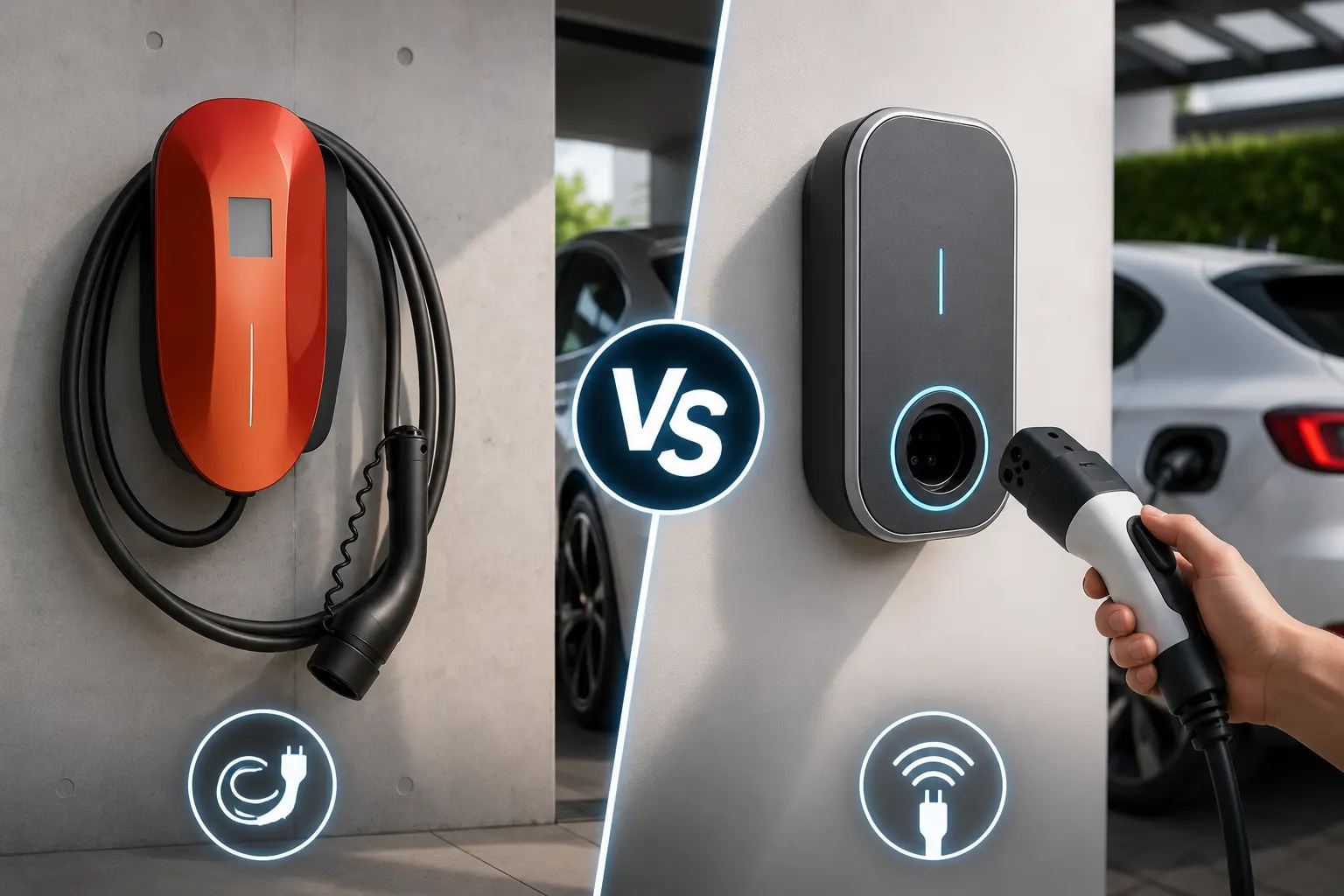
A tethered wallbox includes a permanently attached charging cable.
When charging, the user simply removes the cable from its holder and plugs it directly into the vehicle.
A typical tethered 7.2 kw ac wallbox charger includes:
Fixed charging cable
Wall-mounted cable management
Integrated connector holder
Permanent connection to the charging station
The cable remains attached to the charger at all times.
What Is an Untethered EV Wallbox?
An untethered wallbox does not include a permanently attached charging cable.
Instead, the charger features a charging socket, and users connect a separate charging cable when needed.
The charging cable is typically stored inside the vehicle or garage when not in use.
Most untethered chargers use:
Type 2 sockets in Europe and many international markets
User-supplied charging cables
Replaceable charging accessories
Tethered vs. Untethered Wallbox: Quick Comparison
| Feature | Tethered Wallbox | Untethered Wallbox |
Convenience | Excellent | Good |
Flexibility | Limited | Excellent |
Appearance | More Visible Cable | Cleaner Look |
Cable Replacement | More Complex | Easier |
Multiple Vehicle Compatibility | Moderate | Excellent |
Public Access Suitability | Lower | Higher |
Daily User Experience | Excellent | Good |
Future-Proofing | Moderate | Excellent |
Both charger types can support a 7.2 kw home charger configuration and deliver identical charging performance.
Does Charging Speed Differ Between Tethered and Untethered Models?
No.
This is one of the most common misconceptions among EV buyers.
Whether the charger is tethered or untethered, charging speed depends on:
Charger output power
Vehicle onboard charger
Electrical supply
Battery management system
A tethered 7.2 kw ac fast charger and an untethered 7.2 kw ac charger can both deliver the same charging performance if installed under identical conditions.
The choice is primarily about convenience and flexibility rather than charging speed.
Advantages of a Tethered 7 kW Wallbox
Faster Daily Charging Routine
For drivers who charge every day, convenience matters.
With a tethered charger:
Remove cable
Plug into vehicle
Charging begins
There is no need to retrieve a cable from the vehicle each time.
Over months and years of ownership, this seemingly small difference becomes significant.
Better User Experience During Bad Weather
Rain, snow, and cold temperatures can make charging less pleasant.
A tethered wallbox 7.2 kw eliminates the need to handle and connect a separate cable every day.
Many EV owners consider this the primary reason for choosing a tethered system.
Reduced Risk of Forgotten Cables
An untethered charger depends on having a compatible cable available.
Drivers occasionally forget to:
Return the cable to the vehicle
Bring the cable after cleaning the car
Store the cable properly
A tethered charger eliminates this issue entirely.
Ideal for Dedicated Residential Charging
Tethered chargers work particularly well when:
One household owns one EV
The same parking position is always used
Charging occurs primarily at home
In these scenarios, simplicity often outweighs flexibility.
Advantages of an Untethered 7 kW Wallbox
Cleaner Appearance
Many homeowners prefer the minimalist appearance of untethered chargers.
Without a permanently attached cable:
The charger looks more compact
Installation appears cleaner
Modern architectural aesthetics are maintained
This can be especially important for luxury residential properties.
Easier Cable Replacement
Charging cables experience wear over time.
Potential causes include:
UV exposure
Frequent handling
Vehicle movement
Accidental damage
With an untethered charger, replacing a damaged cable is straightforward and typically less expensive.
Better Compatibility for Multiple EVs
As EV adoption grows, many households own more than one electric vehicle.
Different vehicles may use:
Different cable lengths
Different connector requirements
Different charging scenarios
An untethered 7.2 kw ac wallbox charger allows users to select the most suitable cable for each vehicle.
More Future-Proof
Vehicle technologies evolve.
Connector standards may change in future markets.
An untethered charger provides greater adaptability because the charging cable can be replaced independently of the charging station.
Which Option Is Better for Homeowners?
For most private residential users, tethered chargers provide the best overall experience.
Choose a tethered charger if you:
Charge daily
Own one EV
Prioritize convenience
Want the simplest charging routine
Choose an untethered charger if you:
Own multiple EVs
Value aesthetics
Want maximum flexibility
Prefer easier cable replacement
Considerations for Apartment Buildings and Shared Parking
In shared charging environments, untethered chargers often offer advantages.
Reasons include:
Reduced cable theft risk
Better cable management
Lower maintenance requirements
Greater compatibility among users
Property managers frequently prefer untethered chargers for communal installations.
Which Option Is Better for Commercial Installations?
For workplaces, hotels, fleet depots, and public charging environments, untethered chargers are typically preferred.
Benefits include:
Reduced wear on fixed cables
Lower vandalism risk
Simplified maintenance
Broader vehicle compatibility
Many commercial charging networks standardize on untethered designs for these reasons.
Installation Costs: Is There a Difference?
In most cases, installation costs are very similar.
The primary cost differences arise from:
Charging cable inclusion
Cable length
Cable quality
Smart feature package
The electrical installation requirements for a tethered and untethered 7.2 kw home charger are generally identical.
Both typically require:
Dedicated circuit protection
RCBO or RCD protection
Proper grounding
Professional installation
Maintenance and Long-Term Ownership Costs
Tethered Chargers
Potential considerations:
Fixed cable wear
Higher replacement complexity
Cable exposed to environmental conditions
Untethered Chargers
Potential considerations:
Separate cable purchase
Risk of cable loss
Additional cable storage requirements
Over the long term, maintenance costs are generally comparable, although untethered systems often provide simpler cable replacement.
What Features Matter More Than Tethered vs. Untethered?
Many buyers focus heavily on cable configuration while overlooking features that impact daily performance.
When selecting a 7.2 kw ac fast charger, prioritize:
Smart Charging Functions
Mobile app control
Scheduling
Energy monitoring
Dynamic Load Balancing
Prevents household electrical overload.
Solar Integration
Supports renewable energy utilization.
Safety Protection
Look for:
Overcurrent protection
Surge protection
Leakage current detection
Ground fault monitoring
Weather Resistance
For outdoor installations, consider:
IP65 or higher protection
UV-resistant enclosure
Corrosion-resistant materials
Frequently Asked Questions
Is a tethered charger faster than an untethered charger?
No. Charging speed is determined by power output, vehicle capability, and electrical infrastructure, not cable configuration.
Is a tethered charger easier to use?
Yes. Most homeowners find tethered chargers more convenient because the cable is always attached and ready for use.
Can I replace the cable on a tethered charger?
In many cases, yes, but replacement is generally more complex than replacing a cable used with an untethered charger.
Are untethered chargers better for future EVs?
They can be. Untethered systems offer greater flexibility if connector standards or vehicle requirements change.
Which option is best for a 7.2 kW home charger?
For most single-vehicle households, a tethered 7.2 kw home charger provides the most convenient daily charging experience. For multi-vehicle households or shared charging environments, an untethered solution may offer better long-term flexibility.
Final Thoughts
Both tethered and untethered chargers can deliver identical charging performance when configured as a wallbox 7.2 kw or 7.2 kw ac charger. The decision ultimately comes down to how and where the charger will be used.
Tethered chargers excel in convenience and everyday usability, making them the preferred choice for many homeowners. Untethered chargers provide greater flexibility, cleaner aesthetics, and easier cable replacement, making them attractive for multi-vehicle households, commercial facilities, and future-proof installations.
Before selecting a charging solution, evaluate your parking arrangement, vehicle ownership plans, maintenance preferences, and charging habits. The right choice is the one that best supports your long-term charging needs rather than simply following market trends.
Related Circuit Protection Device From Religare