

Selecting the correct miniature circuit breaker (MCB) is not just about current ratings and tripping curves. One of the most critical yet frequently misunderstood decisions is choosing the proper pole configuration.
Whether you're designing a residential distribution board, a commercial electrical panel, an EV charging installation, or a solar DC system, understanding the differences between 1P, 1P+N, and 2P MCBs is essential for safety, compliance, and long-term reliability.
In general:
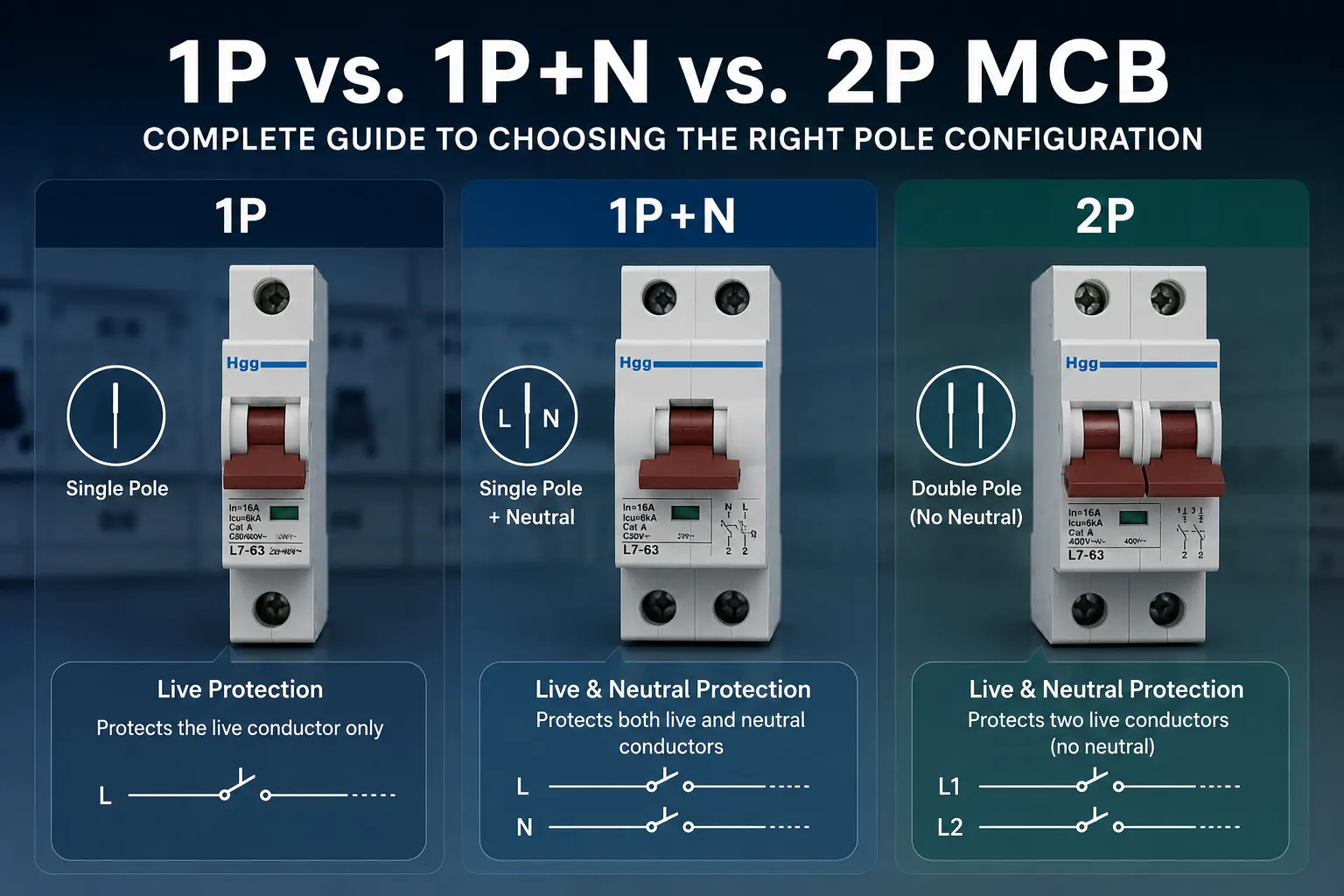
1P MCBs protect and disconnect the live conductor only.
1P+N MCBs protect the live conductor while simultaneously disconnecting both live and neutral.
2P MCBs provide protection and isolation on both poles.
The best choice depends on your electrical system design, local regulations, application type, and maintenance requirements.
Understanding MCB Pole Configurations
The term "pole" refers to the number of conductors that the circuit breaker can switch and/or protect.
| MCB Type | Protected Conductors | Switched Conductors |
1P | Live | Live |
1P+N | Live | Live + Neutral |
2P | Live + Neutral | Live + Neutral |
Although these configurations may appear similar externally, their protection functions differ significantly.
What Is a 1P MCB?
A 1-pole MCB protects only the phase (live) conductor.
When an overload or short circuit occurs:
The live conductor is disconnected.
The neutral conductor remains connected.
Typical Applications
Residential lighting circuits
Socket outlet circuits
Small commercial installations
Branch circuit protection
Advantages
Lowest cost
Compact design
Widely available
Suitable for standard single-phase systems
Limitations
Neutral remains connected during isolation
Reduced maintenance safety compared to multi-pole solutions
Not suitable for applications requiring complete circuit isolation
What Is a 1P+N MCB?
A 1P+N MCB combines:
Thermal and magnetic protection on the live conductor
Simultaneous switching of both live and neutral conductors
Only the phase conductor receives overload and short-circuit protection.
The neutral conductor is switched but not protected.
How It Works
Under fault conditions:
The protected phase pole trips.
The neutral pole opens simultaneously.
This provides improved isolation while maintaining a compact footprint.
Advantages of 1P+N MCBs
Improved Safety During Maintenance
Both conductors are disconnected, reducing the risk of accidental contact with energized circuits.
Better Isolation
Ideal where complete circuit disconnection is required.
Space Savings
Provides dual-pole switching without the larger footprint of some full 2P devices.
Common in EV and Renewable Energy Installations
Frequently used in:
EV charging circuits
Residential solar systems
Sensitive electronic equipment
What Is a 2P MCB?
A 2-pole MCB provides:
Overload protection on both poles
Short-circuit protection on both poles
Simultaneous switching of both conductors
Unlike a 1P+N device, both poles contain full protection mechanisms.
Advantages of 2P MCBs
Full Isolation
Provides complete circuit disconnection.
Enhanced Protection
Both conductors receive protection.
Improved Fault Handling
Useful where reverse currents, supply anomalies, or conductor polarity concerns exist.
Suitable for Critical Systems
Often specified for:
Industrial equipment
Solar PV systems
Battery storage systems
DC applications
1P vs. 1P+N vs. 2P MCB Comparison
| Feature | 1P | 1P+N | 2P |
Phase Protection | Yes | Yes | Yes |
Neutral Protection | No | No | Yes |
Phase Isolation | Yes | Yes | Yes |
Neutral Isolation | No | Yes | Yes |
Cost | Lowest | Medium | Highest |
Installation Space | Smallest | Medium | Largest |
Maintenance Safety | Basic | Good | Excellent |
Suitable for DC Systems | No | Limited | Yes |
Which Pole Configuration Is Best for Residential Installations?
Choose 1P MCB When:
Protecting standard branch circuits
Cost is the primary concern
Local codes permit phase-only isolation
Examples:
Lighting circuits
Standard socket circuits
Small household loads
Choose 1P+N MCB When:
Full circuit isolation is desired
Protecting EV chargers
Protecting inverter outputs
Installing sensitive electronic loads
Many modern residential electrical standards increasingly favor 1P+N protection for enhanced safety.
When Should You Use a 2P MCB?
A 2P MCB is often recommended for:
Solar power systems
Energy storage systems
DC distribution panels
Industrial machinery
Critical power circuits
In these applications, both conductors may carry fault current and require protection.
The additional cost is often justified by increased operational safety and reliability.
Understanding "2 Phase MCB" and "MCB 2 Phase" Terminology
One common source of confusion involves terms such as:
2 phase MCB
two phase MCB
In many markets, these terms are used informally to describe a 2-pole MCB.
Technically, most modern low-voltage systems are:
Single-phase
Three-phase
True two-phase electrical systems are extremely rare today.
Therefore, when customers search for a two phase MCB or 2 phase MCB, they are usually referring to a 2-pole circuit breaker designed to disconnect both live and neutral conductors simultaneously.
2P DC MCB vs. AC MCB: Why the Difference Matters
One of the most important mistakes to avoid is using an AC breaker in a DC application.
Keywords frequently searched include:
2p dc mcb
2 pole dc mcb
dc mcb 2 pole
mcb dc 2 pole
These products are specifically designed for direct current systems.
Why DC Breaking Is More Challenging
Unlike AC current, DC current does not naturally pass through zero voltage multiple times per second.
As a result:
Arc extinction is more difficult
Contact separation requirements are higher
Internal arc chambers are specially designed
Using an AC breaker in a DC circuit can lead to:
Arc persistence
Equipment damage
Fire hazards
Unsafe isolation
Typical Applications for 2P DC MCBs
A 2 pole dc mcb is commonly used in:
Solar PV Systems
Protecting:
PV strings
Combiner boxes
Inverter inputs
Battery Energy Storage Systems
Protecting:
Lithium battery banks
DC distribution circuits
Backup power systems
Telecommunications
Protecting:
48V DC systems
Network infrastructure
Data center backup power
EV Charging Infrastructure
Protecting:
DC auxiliary circuits
Battery storage integration systems
Cost Considerations: Is 2P Always Better?
Not necessarily.
Many buyers assume higher protection levels automatically justify the investment.
However:
| Application | Recommended Option |
Standard lighting | 1P |
Residential sockets | 1P or 1P+N |
EV charging | 1P+N or 2P |
Solar PV | 2P DC MCB |
Battery storage | 2P DC MCB |
Industrial machinery | 2P |
Choosing a larger device than necessary can increase:
Initial cost
Panel space requirements
Installation complexity
The best solution balances safety, compliance, and cost efficiency.
Questions to Ask Before Selecting an MCB
Before purchasing, consider:
What Type of System Is Being Protected?
AC or DC?
Residential or industrial?
Is Full Isolation Required?
If yes, 1P+N or 2P may be preferable.
Do Both Conductors Require Protection?
If yes, a 2P MCB is often the appropriate choice.
What Do Local Electrical Codes Require?
Regulatory requirements vary significantly by country and application.
Frequently Asked Questions
What is the difference between 1P+N and 2P MCB?
A 1P+N MCB protects only the phase conductor while disconnecting both phase and neutral. A 2P MCB protects and disconnects both conductors.
Is a 2 phase MCB the same as a 2-pole MCB?
In most cases, yes. Terms such as 2 phase MCB, two phase MCB, and mcb 2 phase are commonly used to describe a 2-pole circuit breaker.
Can I use an AC MCB in a DC circuit?
No. DC systems should use dedicated devices such as a 2p dc mcb or dc mcb 2 pole designed for DC arc interruption.
Why is a 2 pole DC MCB required in solar systems?
Solar panels generate direct current continuously. A 2 pole dc mcb provides safe isolation and protection for both conductors in the DC circuit.
Is a 1P+N MCB safer than a 1P MCB?
For maintenance and isolation purposes, yes. Because both phase and neutral conductors disconnect simultaneously, a 1P+N MCB generally provides a higher level of operational safety.
Final Thoughts
The choice between 1P, 1P+N, and 2P MCBs should be based on the electrical system, safety requirements, maintenance considerations, and applicable regulations—not simply on price.
For standard residential circuits, 1P MCBs often remain sufficient. For enhanced isolation and modern applications such as EV charging, 1P+N devices offer an excellent balance of safety and cost. Where full conductor protection is required—particularly in solar, battery storage, telecommunications, and DC power systems—a dedicated 2 pole dc mcb, dc mcb 2 pole, or 2p dc mcb is typically the most reliable solution.
By understanding these distinctions before purchasing, installers, panel builders, and electrical contractors can achieve safer installations, easier maintenance, and better long-term system performance.
Related Circuit Protection Device From Religare