

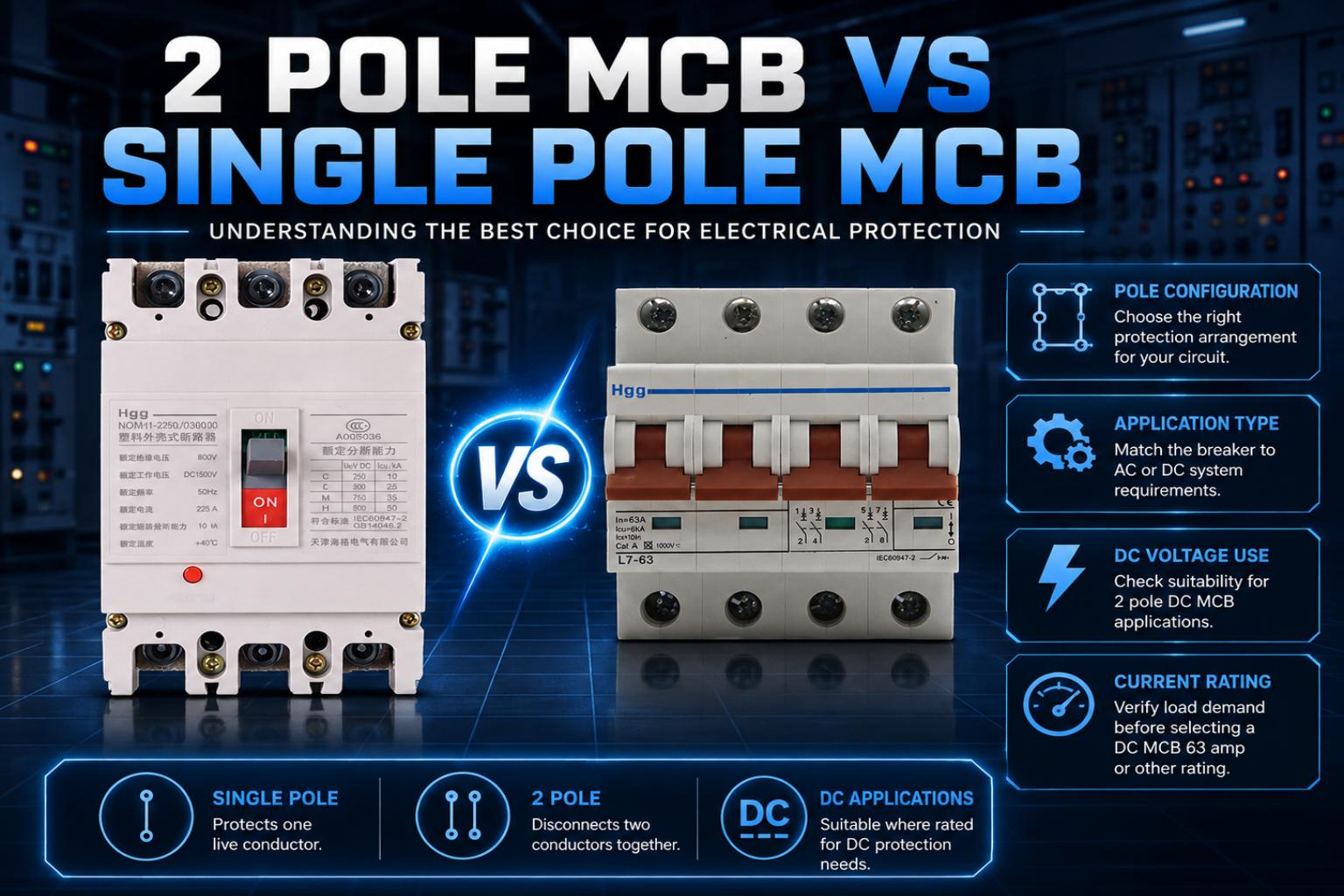
A single pole MCB is generally suitable when only one live conductor needs overcurrent protection and disconnection, while a 2 pole MCB is preferred when two conductors must be disconnected together. The right choice therefore depends on the circuit configuration, operating voltage, AC or DC system, isolation requirements, and applicable electrical standards.
Although 2 phase mcb and two phase mcb are common search terms, “2 pole MCB” is usually the more technically accurate description. A two-pole breaker does not necessarily mean that the electrical supply itself is a two-phase system.
What Is the Difference Between a Single Pole and 2 Pole MCB?
The fundamental difference is the number of conductors operated simultaneously.
A single pole MCB interrupts one conductor when an overload or short circuit occurs. It is commonly used where protection of one live conductor is sufficient.
A 2 pole MCB has two mechanically linked poles, allowing both conductors to be disconnected together when the breaker trips or is manually switched off. Multi-pole MCBs are designed so their poles operate together rather than independently.
| Selection Factor | Single Pole MCB | 2 Pole MCB |
|---|---|---|
| Conductors switched | One | Two simultaneously |
| Space requirement | Smaller | Wider |
| Isolation | One conductor | Two conductors |
| Typical use | Individual AC circuits | Circuits requiring simultaneous disconnection |
| DC suitability | Depends on rated DC voltage | Often selected for higher DC system voltages |
The deciding factor should not simply be panel space or price. Engineers should first determine which conductors need protection and isolation.
Can a 2 Pole MCB Be Used for Single-Phase Circuits?
Yes. A two-pole breaker can be used in a single-phase installation when the circuit design requires two conductors to be disconnected simultaneously.
This is one reason the term 2 phase mcb can cause confusion. A two-pole breaker may still be protecting a single-phase circuit. The number of poles describes the breaker's switching arrangement, not automatically the number of electrical phases.
Whether the neutral should also be disconnected depends on the earthing arrangement, system design, equipment requirements, and local electrical regulations.
When Should You Choose a 2 Pole DC MCB?
DC circuit protection requires particular attention because interrupting direct current can be more demanding than interrupting AC. The breaker must therefore be specifically rated for the DC voltage and connection arrangement involved.
A 2 pole dc mcb may be appropriate for solar PV circuits, battery systems, energy storage equipment, DC control systems, telecommunications power supplies, and other DC distribution applications where two-pole disconnection or a higher supported DC voltage is required.
Manufacturer ratings must always be checked carefully. For example, some dedicated DC MCB ranges support a higher rated DC voltage when two poles are connected according to the specified configuration than when a single pole is used. ABB documentation, for example, lists certain DC MCBs at up to 220 V DC for one pole and 440 V DC for two poles.
This does not mean every 2 pole MCB automatically supports the same voltage. Always follow the manufacturer's wiring diagram, voltage rating, polarity marking, and short-circuit capacity.
Is a DC MCB 63 Amp Suitable for Every 63A Circuit?
Not necessarily.
Selecting a dc mcb 63 amp requires more than matching the breaker marking to a calculated 63A load. Engineers should also verify:
Rated DC operating voltage
Cable current-carrying capacity
Breaking capacity
Trip curve
Ambient temperature
Continuous operating current
Number of poles and required connection method
A 63A breaker should protect the conductors and equipment without nuisance tripping during normal operation. At the same time, oversizing the breaker can reduce effective overload protection.
The available short-circuit current is equally important. A dc mcb 63 amp with an insufficient interrupting capacity should not be selected simply because its current rating matches the load.
Which Is Better: Single Pole or 2 Pole MCB?
Neither is universally better.
Choose a single pole MCB when the electrical system only requires one conductor to be protected and switched. Choose a 2 pole MCB when simultaneous disconnection of two conductors is required or when the manufacturer's specified DC configuration uses two poles to achieve the required operating voltage.
For industrial or DC installations, evaluate the application in this order:
System voltage → AC or DC → conductors requiring disconnection → load current → breaking capacity → trip characteristic → installation requirements.
Following this sequence is more reliable than choosing a breaker based only on the label 2 phase mcb, pole count, or rated current.
Frequently Asked Questions
Does a 2 pole MCB mean two-phase power?
No. A 2 pole MCB describes a breaker with two linked poles. The commonly searched terms 2 phase mcb and two phase mcb are often used to describe double-pole breakers, but they do not necessarily indicate a true two-phase electrical supply.
Can I use an AC MCB for a DC circuit?
Only if the manufacturer explicitly provides an appropriate DC rating and connection method for that breaker. Never assume an AC voltage rating can be applied directly to DC.
Why use two poles in a DC circuit?
A 2 pole dc mcb can provide simultaneous disconnection and, depending on the breaker design, may support a higher DC operating voltage when the poles are connected in the manufacturer's specified arrangement.
How do I choose between a 1P and 2P MCB?
Determine which conductors must be disconnected, then check system voltage, current, short-circuit level, AC/DC compatibility, isolation requirements, and applicable electrical standards.
Conclusion
The choice between a single pole and 2 pole MCB should be based on circuit architecture rather than pole count alone. Single pole devices are efficient for circuits requiring protection of one conductor, while two-pole breakers provide simultaneous disconnection and are especially important in applications requiring greater isolation or specific DC configurations.
For applications involving a 2 pole dc mcb or dc mcb 63 amp, voltage rating, breaking capacity, polarity, wiring configuration, and load conditions should all be confirmed before installation. Religare Electric offers MCB solutions for different AC and DC protection requirements, helping OEMs, distributors, panel builders, and electrical system designers select suitable configurations for their applications.
Related Circuit Protection Device From Religare