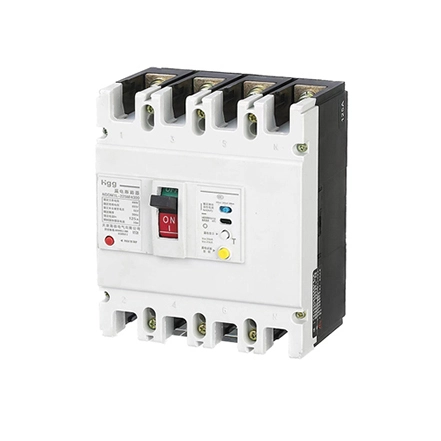


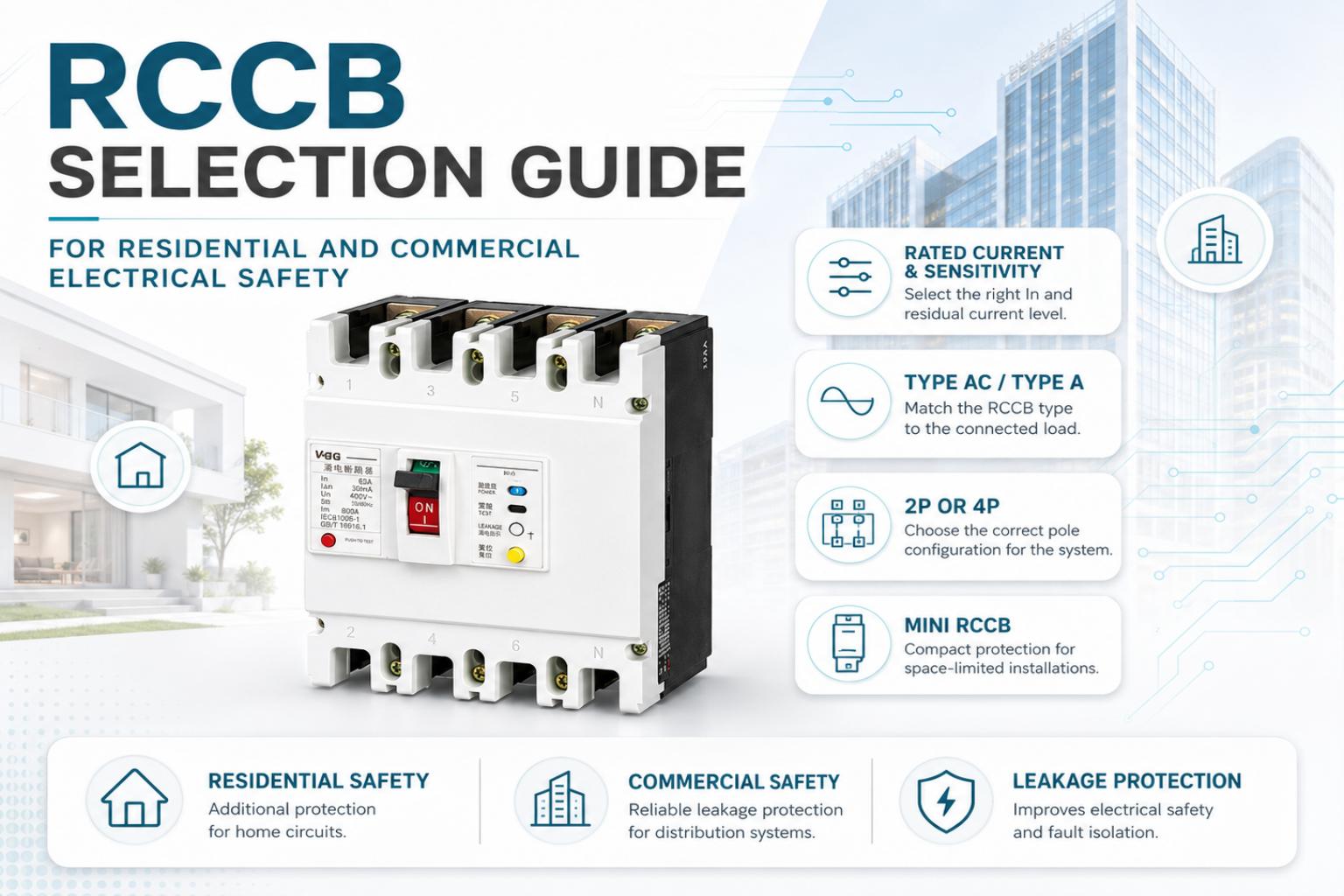
Choosing an RCCB should start with five parameters: rated current, residual-current sensitivity, RCCB type, number of poles, and the characteristics of the connected loads. For residential circuits, 30 mA protection is widely used where additional protection against electric shock is required, while commercial distribution may require a combination of sensitivities and selective protection across different levels of the system.
An RCCB should not be selected as a replacement for an MCB. Its primary function is residual-current protection; overcurrent and short-circuit protection normally needs to be provided by an appropriate MCB, MCCB, fuse, or by using an RCBO that combines the functions.
What RCCB Rating Should You Choose?
Two current values need to be distinguished when selecting an RCCB:
Rated current (In) indicates the continuous current the device is designed to carry, such as 25 A, 40 A, 63 A, 80 A, or 100 A.
Rated residual operating current (IΔn) indicates the earth-leakage level at which the RCCB is designed to operate, commonly 30 mA, 100 mA, or 300 mA depending on the application.
These values serve different purposes. A 63 A / 30 mA RCCB, for example, is designed to carry up to its rated current under specified conditions while providing 30 mA residual-current protection.
Commercial RCCB ranges commonly provide several combinations of rated current and sensitivity rather than a single universal specification. Schneider Electric, for example, lists RCCBs with rated currents from 16 A to 100 A and residual-current sensitivities including 10, 30, 100, 300, and 500 mA.
The RCCB rated current should therefore be coordinated with the upstream overcurrent protective device and expected circuit loading rather than selected from leakage sensitivity alone.
Is a 30 mA RCCB Better Than a 100 mA or 300 mA RCCB?
Not necessarily. The correct sensitivity depends on what the RCCB is intended to protect.
A 30 mA RCCB is commonly selected for additional protection against electric shock in final circuits. Higher residual-current settings such as 100 mA or 300 mA may be used in upstream or other applications where fire protection, discrimination, or avoidance of unnecessary tripping is part of the protection strategy.
Manufacturers offer different sensitivities for this reason; ABB RCCB ranges, for example, include 30 mA, 100 mA, and 300 mA versions across common current ratings.
Simply installing 30 mA protection at every level of a commercial distribution system can create poor selectivity. If several downstream circuits have normal leakage current, an upstream highly sensitive RCCB may trip unnecessarily and disconnect a much larger part of the installation.
Commercial systems should therefore be designed around the complete protection hierarchy.
Type AC or Type A RCCB: Which Should You Select?
The connected equipment matters increasingly when choosing RCCB type.
Type AC RCCBs respond to sinusoidal AC residual currents. Type A RCCBs are designed to detect AC residual currents as well as pulsating DC residual currents associated with many electronic loads.
This distinction is increasingly relevant because modern residential and commercial buildings contain equipment such as electronic power supplies, appliances with electronic controls, LED systems, IT equipment, and other power-electronic devices.
Hager, for example, specifies Type A RCCBs for AC and pulsating DC residual-current protection, including products intended for residential and light-commercial distribution.
Selection should still follow the equipment manufacturer's requirements and applicable local electrical standards. More specialised loads may require other RCD types rather than assuming Type A is sufficient for every electronic application.
Should You Choose a 2-Pole or 4-Pole RCCB?
Pole configuration should match the electrical distribution system.
A 2-pole RCCB is commonly used for single-phase circuits where the live and neutral conductors pass through the RCCB. A 4-pole RCCB is generally associated with three-phase systems with neutral.
For commercial panels, the decision should also consider whether the loads are balanced, how the neutral is distributed, and whether downstream circuits require separate residual-current protection.
For example:
| Application | Typical RCCB Configuration | Key Consideration |
|---|---|---|
| Residential single-phase board | 2P | Live and neutral monitoring |
| Small commercial single-phase circuit | 2P | Load type and leakage current |
| Three-phase commercial distribution | 4P | Three phases plus neutral |
| Multiple commercial final circuits | Multiple RCCBs/RCBOs | Selectivity and fault containment |
A single RCCB protecting an entire commercial installation may reduce equipment cost, but it can also cause unnecessary system-wide shutdown when a fault occurs on only one circuit.
When Does a Mini RCCB Make Sense?
A mini RCCB is useful where distribution-board space is limited and residual-current protection needs to be integrated into a compact electrical design.
Typical applications can include compact residential consumer units, modular control panels, small commercial distribution systems, prefabricated electrical assemblies, and equipment where DIN-rail space is tightly controlled.
However, physical size should never become the main selection criterion.
Before specifying a mini RCCB, engineers should verify:
rated current and residual sensitivity;
number of poles;
RCCB type;
rated voltage;
conditional short-circuit capability and required upstream protection;
terminal capacity;
applicable certification and standards.
A compact RCCB is valuable only when it provides the electrical characteristics required by the installation.
What Should Commercial Projects Check Beyond the RCCB Rating?
Commercial applications require greater attention to leakage-current coordination.
Electronic equipment can create small normal leakage currents even when no dangerous insulation fault exists. When many devices operate on the same RCCB, these currents can accumulate and reduce the margin before unwanted tripping occurs.
A better design may divide lighting, socket circuits, HVAC equipment, IT loads, and other important circuits into separate protection groups.
Where continuity of supply is important, engineers should also assess selectivity between upstream and downstream residual-current devices. The objective is for the protective device closest to the fault to operate without unnecessarily disconnecting healthy circuits.
This consideration is particularly important for offices, retail facilities, workshops, data-related facilities, and other sites where one RCCB trip could otherwise interrupt multiple operational areas.
What Is the Difference Between an RCCB and an MCB?
An MCB primarily protects wiring against overload and short-circuit current, while an RCCB detects an imbalance between conductors caused by residual current flowing outside the intended circuit path.
An RCCB therefore should not be relied upon by itself for conventional overcurrent protection.
Where both functions are required within one device, an RCBO may be appropriate. Where separate devices are preferred, the RCCB must be correctly coordinated with the associated MCB, MCCB, or fuse.
This distinction is one of the most important points to confirm when comparing products from residual current circuit breaker manufacturers.
Frequently Asked Questions
Can an RCCB protect against a short circuit?
An RCCB is primarily intended for residual-current protection and should not be treated as a substitute for an overcurrent protective device. Short-circuit and overload protection must be provided according to the system design, often using an MCB, MCCB, fuse, or RCBO.
Why does an RCCB trip even when there is no obvious fault?
Possible causes include accumulated leakage from several electronic devices, insulation deterioration, moisture, wiring problems, neutral-to-earth connections downstream of the RCCB, or an actual intermittent earth fault. Repeated tripping should be investigated rather than solved by simply installing a less-sensitive RCCB.
Is a 63 A RCCB suitable for a 63 A load?
Not automatically. The RCCB rating must be coordinated with cable capacity, upstream protection, installation conditions, load characteristics, and manufacturer requirements. Residual-current sensitivity must also be selected separately.
How often should an RCCB be tested?
RCCBs include a test function to verify the operating mechanism. The required testing interval should follow the manufacturer's instructions and applicable local electrical regulations.
Choosing Reliable RCCB Products for a Project
For OEMs, panel builders, distributors, and electrical contractors, selecting between residual current circuit breaker manufacturers involves more than comparing current ratings and price.
Reliable residual current circuit breaker suppliers should be able to provide clear information on rated current, residual sensitivity, RCCB type, pole configuration, applicable standards, product certification, operating environment, and available configurations.
For projects requiring a conventional RCCB or space-saving mini RCCB, provide the supplier with the system voltage, number of phases, expected load current, required leakage sensitivity, load characteristics, and installation environment. This allows the protection device to be matched to the actual electrical system rather than selected from a catalogue rating alone.
Conclusion
Effective RCCB selection requires the rated current, residual-current sensitivity, RCCB type, pole configuration, load characteristics, and protection coordination to be considered together.
Residential installations commonly prioritise personal protection and straightforward circuit segmentation, while commercial systems require greater attention to accumulated leakage, continuity of supply, and selective operation between different protection levels.
By matching the RCCB to the actual electrical environment rather than selecting by amperage alone, designers can achieve safer protection with fewer nuisance trips and better fault containment.
Related Circuit Protection Device From Religare