

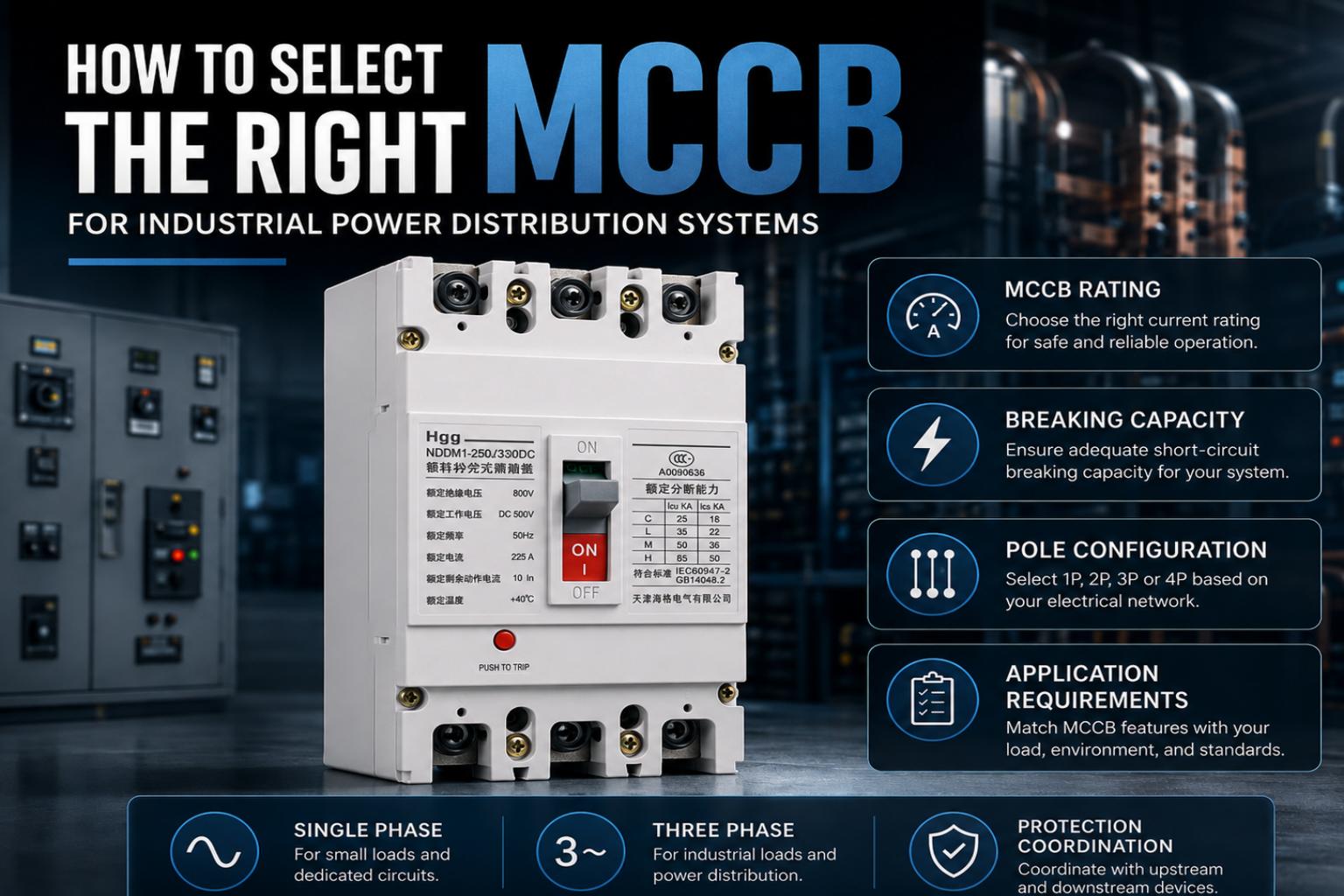
Selecting the right molded case circuit breaker for an industrial power distribution system requires more than matching the breaker current to the connected load. Engineers should evaluate the MCCB rating, system voltage, prospective short-circuit current, pole configuration, load characteristics, trip settings, and coordination with upstream and downstream protective devices.
For most industrial installations, the correct MCCB is one that can carry the normal operating current without nuisance tripping while safely interrupting the maximum fault current expected at its installation point. Motor starting, transformer inrush, ambient conditions, future load expansion, and the required level of selectivity should also influence the final selection.
What MCCB Rating Should Be Selected for an Industrial Load?
The MCCB rating should be selected according to the actual design current of the protected circuit rather than simply choosing the next available breaker size.
Start by determining the maximum operating current of the load and verifying that the selected breaker is appropriate for the conductor capacity and installation conditions. For continuous industrial loads, additional margin may be required according to the applicable electrical code, breaker design, and equipment specifications.
A breaker that is significantly oversized may not provide sufficiently sensitive overload protection. One that is too close to normal operating current may trip during temporary load increases.
For industrial applications, engineers should therefore check several ratings together:
Rated current and adjustable trip-current range
Rated operational voltage
Ultimate short-circuit breaking capacity
Service short-circuit breaking capacity
Number of poles
Trip-unit characteristics
The short-circuit rating is especially important. The breaker's interrupting capacity must be suitable for the prospective fault current at the actual installation point, not merely the normal load current.
Should You Use an MCCB for Single-Phase or Three-Phase Systems?
Pole configuration should follow the electrical system and protection requirements.
An mccb single phase configuration may be used for higher-current single-phase feeders, industrial heating circuits, auxiliary distribution, equipment supplies, and other applications where an MCB does not provide the required current capacity or fault-breaking performance.
For single-phase systems, designers must also determine whether only the live conductor or both live and neutral conductors need to be switched or isolated according to the system arrangement and applicable standards.
A three phase mccb, by comparison, is widely used in industrial distribution boards, motor circuits, production equipment, HVAC systems, pumps, compressors, and three-phase feeder circuits.
Three-pole MCCBs are common where the three phase conductors require simultaneous protection and disconnection. A four-pole arrangement may be required when the neutral must also be switched, particularly where the system design or operating conditions make neutral isolation necessary.
The decision should therefore be based on the distribution architecture rather than selecting pole count from load current alone.
How Does Breaking Capacity Affect MCCB Selection?
Breaking capacity determines whether the MCCB can safely interrupt a severe short circuit.
Two common IEC parameters are:
Icu – Rated ultimate short-circuit breaking capacity: the maximum fault current that the breaker is designed to interrupt under specified test conditions.
Ics – Rated service short-circuit breaking capacity: an indication of the breaker's ability to interrupt specified fault currents while maintaining the required level of service capability afterward.
For a proper molded case circuit breaker application, engineers should calculate or obtain the prospective short-circuit current at the installation point and select an MCCB with a suitable interrupting rating.
This becomes particularly important near transformers and main distribution boards, where available fault current can be substantially higher than at downstream circuits.
Choosing a breaker solely because it has the correct ampere rating can therefore be a serious design error. A 250 A MCCB with insufficient breaking capacity may be unsuitable even though its normal-current rating appears correct.
How Should MCCBs Be Selected for Motors and Other Industrial Loads?
Industrial loads rarely behave like simple resistive loads.
Motors can draw substantial current during starting. Transformers can produce temporary magnetising inrush, while welding equipment, compressors and other cyclic loads may create rapidly changing current demand.
The MCCB must distinguish these normal operating conditions from genuine overloads and short circuits.
For a motor feeder, for example, simply reducing the MCCB rating to obtain tighter protection can create nuisance tripping during acceleration. The better approach is to evaluate motor full-load current, starting method, starting current and starting duration together with the MCCB trip characteristics and any dedicated motor protection device.
Where the distribution system contains different types of industrial loads, an adjustable thermal-magnetic or electronic trip unit can provide greater flexibility than a fixed protection setting.
Electronic trip units can be particularly useful where engineers need more precise adjustment of long-time, short-time and instantaneous protection or improved coordination between different levels of the distribution system.
Why Is Selectivity Important in Industrial Power Distribution?
An industrial protection system should not only disconnect a fault; it should disconnect the smallest practical section of the system affected by that fault.
For example, a short circuit on one production machine should ideally trip its feeder breaker rather than the main MCCB supplying the entire workshop.
This is why MCCB selection should include coordination between the main incomer, sub-distribution breakers and final circuit protection.
When evaluating a three phase mccb for a distribution panel, engineers should review its trip curve and settings together with downstream protective devices. If the instantaneous settings overlap excessively, a downstream fault may cause several breakers to open simultaneously.
Selective coordination is especially important in manufacturing plants, data infrastructure, process facilities and other installations where an unnecessary shutdown can cause significant production losses.
What Factors Should Be Checked Before Choosing an MCCB?
Before confirming an MCCB, review the complete operating environment rather than relying on the current rating alone.
Important considerations include system voltage and frequency, maximum load current, prospective short-circuit current, conductor size, number of poles, load type, starting or inrush current, ambient temperature, enclosure conditions and the required protection coordination.
The required molded case circuit breaker application also affects the choice of accessories. Industrial switchboards may require auxiliary contacts, alarm contacts, shunt trips, undervoltage releases or remote operating mechanisms to integrate the MCCB with control and monitoring systems.
Future expansion should also be considered, but excessive oversizing should be avoided. Protection should remain appropriate for the installed conductors and equipment.
Frequently Asked Questions
What is the difference between a 3-pole and 4-pole MCCB?
A 3-pole MCCB switches the three phase conductors together. A 4-pole MCCB also provides switching of the neutral conductor. Whether neutral switching is required depends on the electrical system, application and applicable installation requirements.
Can an MCCB be used on a single-phase supply?
Yes. An mccb single phase solution can be appropriate for higher-current single-phase circuits where the load, fault level or protection requirements exceed the practical range of an MCB. The correct pole configuration must still match the circuit and isolation requirements.
How do I choose the correct MCCB rating?
Determine the circuit design current, conductor capacity, system voltage and load characteristics first. Then choose a suitable MCCB rating and trip setting that can carry normal operating current while providing effective overload protection. Breaking capacity must also be checked against the available short-circuit current.
Is a higher breaking capacity MCCB always better?
A higher breaking capacity provides additional fault-interruption capability, but it should be selected according to the calculated short-circuit level and system requirements. Specifying unnecessarily high performance can increase cost without improving the practical protection of a correctly designed system.
Conclusion
The right MCCB for industrial power distribution is selected by considering current, voltage, breaking capacity, pole configuration, load behaviour and protection coordination as one complete system.
Whether the project requires an mccb single phase solution for an auxiliary feeder or a three phase mccb for major industrial distribution, the breaker should be matched to the actual electrical conditions rather than selected from current rating alone.
For OEMs, panel builders and industrial electrical projects, Religare Electric provides MCCB solutions for different circuit protection and power distribution requirements. Providing system voltage, load current, pole configuration and expected fault-current information when requesting a product recommendation can help identify a more appropriate MCCB configuration for the application.
Related Circuit Protection Device From Religare