

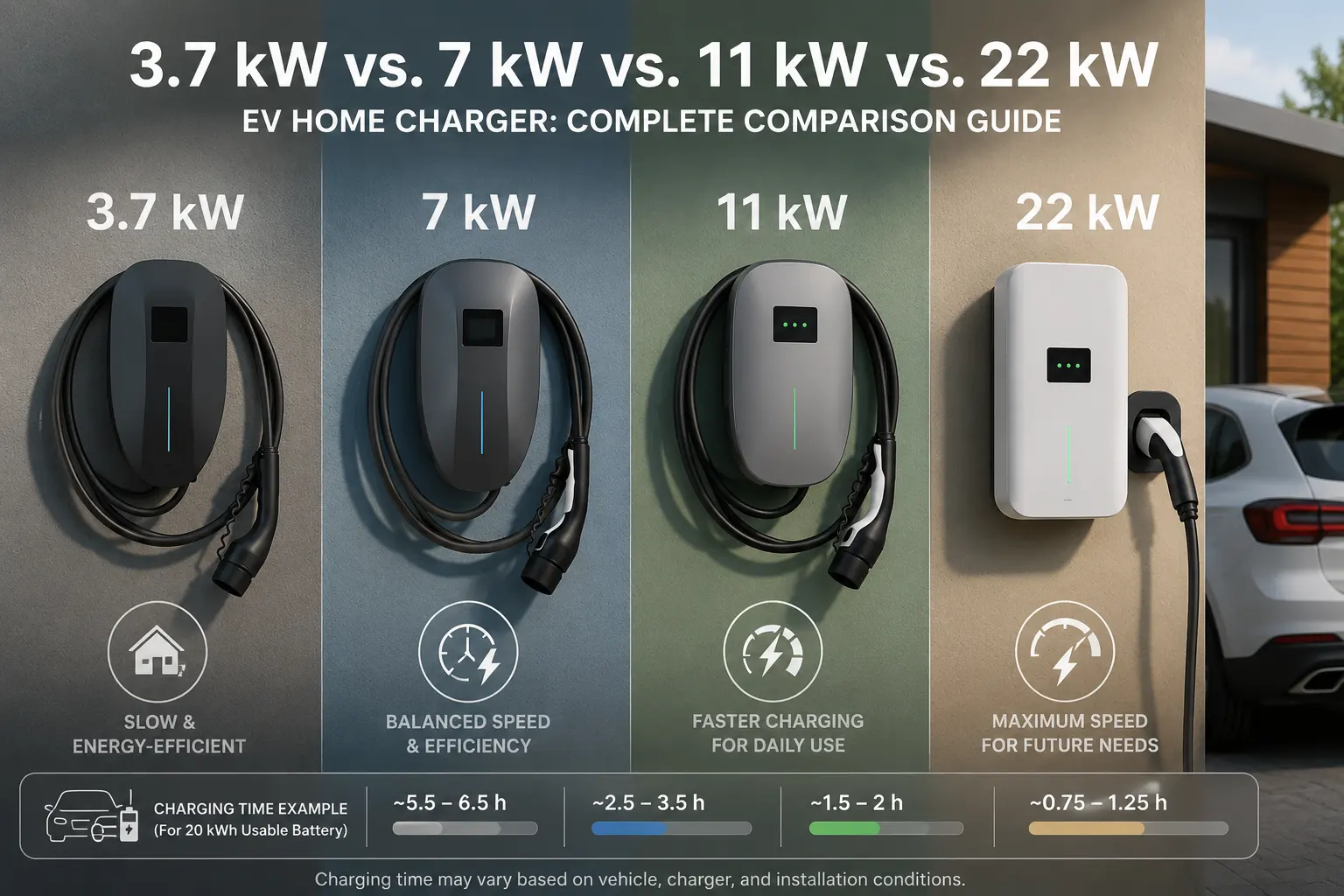
Choosing the right EV home charger is not simply about selecting the highest power rating available. The ideal charger depends on your vehicle's onboard charger capacity, your home's electrical infrastructure, daily driving habits, installation budget, and future charging requirements.
For most residential EV owners, a 7 kW charger offers the best balance of charging speed, installation cost, and compatibility. However, a 3.7 kW wallbox remains a practical solution for low-mileage drivers, while 11 kW and 22 kW chargers are better suited to homes with three-phase power supplies and vehicles capable of accepting higher AC charging rates.
This guide compares 3.7 kW, 7 kW, 11 kW, and 22 kW EV chargers from a real-world perspective to help you make an informed investment.
EV Home Charger Power Ratings at a Glance
| Charger Power | Power Supply | Typical Charging Speed* | Best For |
3.7 kW | Single-phase | 15-25 km range/hour | Plug-in hybrids, low-mileage EV owners |
7 kW | Single-phase | 30-50 km range/hour | Most residential EV users |
11 kW | Three-phase | 50-70 km range/hour | Homes with three-phase power |
22 kW | Three-phase | 90-130 km range/hour | High-end EVs, fleet users, commercial properties |
*Actual charging speed depends onvehicle efficiency and onboard charger limitations.
Understanding the Difference Between Charger Power and Charging Speed
One of the most common misconceptions among EV buyers is assuming that a higher-rated charger always results in faster charging.
In reality, charging speed is determined by three factors:
EV charger output power
Vehicle onboard charger capacity
Electrical supply available at the property
For example:
A 22 kW charger connected to a vehicle that only supports 7 kW AC charging will still charge at approximately 7 kW.
Therefore, before selecting a charger, always verify your vehicle's AC charging specifications.
3.7 kW Home Charger: Entry-Level Residential Charging
A 3.7 kw home charger operates on a standard single-phase electrical supply and is often considered the entry-level dedicated EV charging solution.
Advantages of a 3.7 kW Wallbox
Lower equipment cost
Simplified installation
Reduced electrical load on household circuits
Suitable for overnight charging
Limitations
Long charging times for larger battery EVs
Less future-proof as battery capacities continue increasing
Not ideal for high daily mileage users
Typical Charging Time
| Battery Capacity | Approximate Charging Time |
40 kWh | 11-12 hours |
60 kWh | 16-18 hours |
75 kWh | 20-22 hours |
Who Should Choose a 3.7 kW Wallbox?
A 3.7 kw wallbox is typically suitable for:
Plug-in hybrid vehicle owners
Drivers covering less than 50 km per day
Locations with limited electrical capacity
Budget-conscious homeowners
7 kW Home Charger: The Most Popular Residential Choice
The 7 kW charger has become the standard recommendation for residential EV charging worldwide.
It uses single-phase power while providing nearly double the charging speed of a 3.7 kW unit.
Advantages
Excellent balance between cost and performance
Compatible with most residential electrical systems
Widely supported by modern EVs
Shorter charging times
Typical Charging Time
| Battery Capacity | Approximate Charging Time |
40 kWh | 5-6 hours |
60 kWh | 8-9 hours |
75 kWh | 10-11 hours |
Best Applications
Daily commuters
Family EV ownership
Overnight charging
Most detached houses
For many EV owners, upgrading from a 3.7 kW charger to 7 kW significantly improves charging convenience without requiring expensive electrical upgrades.
11 kW EV Charger: Faster Charging with Three-Phase Power
An 11 kW charger requires a three-phase electrical supply and can substantially reduce charging times for compatible vehicles.
Key Benefits
Faster charging than 7 kW systems
Lower current per phase improves electrical balance
Excellent option for larger battery EVs
Potential Drawbacks
Higher installation costs
Three-phase power not available in many homes
Vehicle must support 11 kW AC charging
Typical Charging Time
| Battery Capacity | Approximate Charging Time |
40 kWh | 3.5-4 hours |
60 kWh | 5-6 hours |
75 kWh | 7 hours |
Ideal Users
Premium EV owners
Homes already equipped with three-phase power
Multi-vehicle households
Drivers requiring rapid overnight charging
22 kW EV Charger: Maximum AC Charging Performance
The 22 kW charger represents the highest commonly available AC charging power for residential and light commercial applications.
Advantages
Extremely fast AC charging
Suitable for fleet operations
Supports multiple daily charging cycles
Future-ready infrastructure
Limitations
Significant installation costs
Requires three-phase electrical supply
Many EVs cannot utilize full 22 kW charging
Typical Charging Time
| Battery Capacity | Approximate Charging Time |
40 kWh | 2 hours |
60 kWh | 3 hours |
75 kWh | 4 hours |
Best Applications
Commercial premises
Company vehicle fleets
Luxury residential properties
Hotels and hospitality facilities
Comparison of Installation Costs
While equipment pricing varies by region and manufacturer, installation costs often influence the final purchasing decision more than charger cost alone.
| Charger Rating | Relative Installation Cost |
3.7 kW | Low |
7 kW | Low to Moderate |
11 kW | Moderate to High |
22 kW | High |
Additional expenses may include:
Consumer unit upgrades
Circuit protection devices
Cable runs
Grounding improvements
Load balancing systems
Utility approval requirements
Does a Higher-Power Charger Increase Electricity Bills?
No.
A higher-power charger does not inherently increase electricity consumption.
Charging a 60 kWh battery requires approximately the same amount of electricity whether charging occurs through:
3.7 kW charger
7 kW charger
11 kW charger
22 kW charger
The difference is simply how quickly the energy is delivered.
Electricity costs depend on:
Local energy tariffs
Charging schedule
Total energy consumed
Smart chargers can reduce costs by automatically charging during off-peak periods.
Can Every EV Use an 11 kW or 22 kW Charger?
No.
The vehicle's onboard charger determines the maximum AC charging rate.
Examples:
| Vehicle AC Charging Capability | Maximum Charging Speed |
3.7 kW | 3.7 kW |
7.4 kW | 7.4 kW |
11 kW | 11 kW |
22 kW | 22 kW |
Installing a 22 kW charger for a vehicle limited to 7 kW will not improve charging speed.
Always check manufacturer specifications before purchasing.
Which EV Home Charger Is Best for Future-Proofing?
Future-proofing depends on your electrical infrastructure.
If You Have Single-Phase Power
A 7 kW charger is generally the best long-term investment.
Benefits include:
Broad EV compatibility
Faster charging than a 3.7 kW wallbox
Reasonable installation cost
Suitable for future EV upgrades
If You Have Three-Phase Power
An 11 kW charger often delivers the best value.
It offers:
Fast charging
Lower installation complexity than 22 kW systems
Compatibility with many newer EV models
For Commercial and Fleet Applications
22 kW chargers provide the greatest operational flexibility and charging throughput.
Frequently Asked Questions
Is a 3.7 kW home charger sufficient for an electric vehicle?
Yes. A 3.7 kw home charger can adequately support drivers with low daily mileage and overnight charging availability. However, charging times become lengthy for EVs with battery capacities above 60 kWh.
Is a 7 kW charger worth the extra cost over a 3.7 kW wallbox?
For most EV owners, yes. The improved charging speed significantly enhances convenience while installation costs often remain manageable.
Can I install an 11 kW charger in any home?
No. An 11 kW charger typically requires a three-phase electrical supply. Many residential properties only have single-phase service.
Is a 22 kW charger too powerful for home use?
For many households, yes. Unless your vehicle supports 22 kW AC charging and your home has three-phase power, the benefits may not justify the additional installation cost.
Which charger should I choose for a new EV purchase?
Most homeowners should select either a 7 kW charger or an 11 kW charger depending on available electrical infrastructure and vehicle compatibility.
Final Thoughts
Selecting the right EV charger requires balancing charging performance, installation costs, electrical capacity, and future vehicle requirements.
A 3.7 kw wallbox remains a practical option for light-duty charging and plug-in hybrids. However, the majority of EV owners will benefit from a 7 kW charger, which provides an excellent combination of affordability and convenience. Homes equipped with three-phase power may find 11 kW charging to be the ideal upgrade, while 22 kW chargers are best reserved for demanding residential, commercial, or fleet applications.
Before making a purchase, verify your home's electrical supply and your vehicle's maximum AC charging capability to ensure you invest in a charger that delivers meaningful real-world value.
Related Circuit Protection Device From Religare