

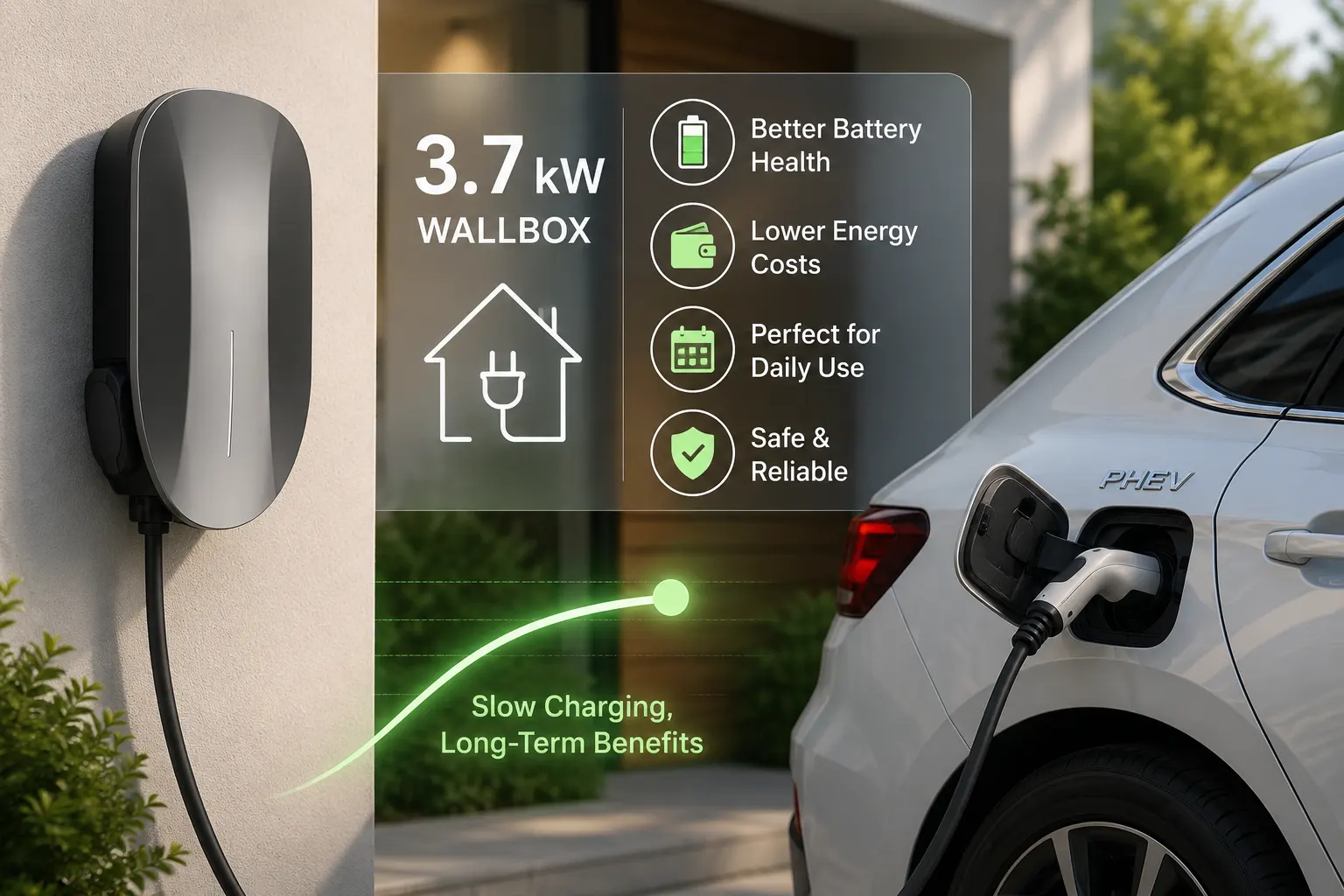
Many plug-in hybrid (PHEV) owners assume that faster charging is always better. In reality, for most PHEVs and many low-mileage electric vehicle users, a 3.7 kW wallbox is often the most practical and cost-effective home charging solution.
Because plug-in hybrids typically have smaller battery packs ranging from 8 kWh to 25 kWh, they can usually be fully charged overnight with a 3.7 kW home charger. Higher-power chargers often provide little real-world benefit while increasing installation complexity and upfront costs.
This guide explains why a 3.7 kW wallbox remains a smart investment for PHEV owners, what applications it suits best, and how it compares with higher-powered charging options.
What Is a 3.7 kW Wallbox?
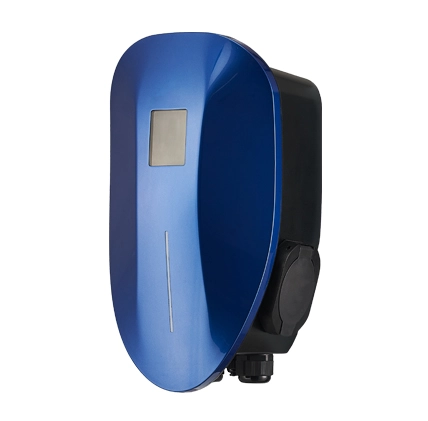
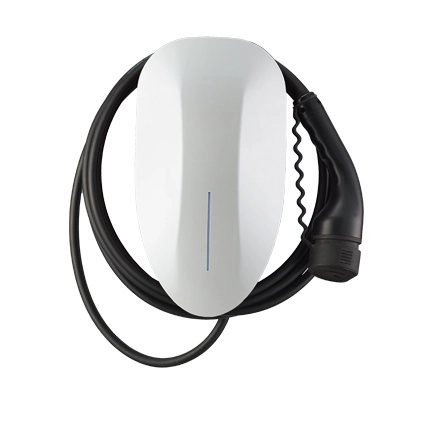
A 3.7 kW wallbox is a dedicated AC EV charging station designed for residential use. It typically operates on a single-phase electrical supply and delivers up to 16A of charging current.
Compared with a standard household socket, a wallbox offers:
Enhanced charging safety
Dedicated circuit protection
Better charging efficiency
Smart charging features
Improved durability for daily use
Although 3.7 kW may seem modest compared to 7 kW or 22 kW chargers, it aligns remarkably well with the charging requirements of many plug-in hybrid vehicles.
Why PHEVs Rarely Need High-Power Home Charging
One of the biggest mistakes buyers make is choosing charger power based solely on marketing claims rather than actual vehicle usage.
Consider typical PHEV battery capacities:
| Vehicle Type | Typical Battery Size |
Small PHEV | 8-12 kWh |
Mid-Size PHEV | 13-18 kWh |
Large SUV PHEV | 18-25 kWh |
At 3.7 kW charging power:
| Battery Capacity | Charging Time |
10 kWh | 2.5-3 hours |
15 kWh | 4-5 hours |
20 kWh | 5-6 hours |
25 kWh | 6-8 hours |
For drivers who park at home overnight, these charging times are typically more than sufficient.
In many cases, a vehicle is fully charged long before the owner wakes up the next morning.
The Real Advantages of a 3.7 kW Home Charger
Lower Installation Costs
A 3.7 kW home charger generally requires less electrical infrastructure than higher-power charging systems.
Potential savings may include:
Smaller cable sizes
Lower circuit breaker ratings
Reduced electrical upgrades
Simpler installation process
For older homes with limited electrical capacity, avoiding expensive service upgrades can significantly improve the return on investment.
Reduced Load on Household Electrical Systems
Residential electrical panels often support multiple high-power appliances simultaneously:
Air conditioning systems
Electric water heaters
Ovens
Heat pumps
Washing machines
Adding a high-power EV charger can increase peak demand and potentially require electrical upgrades.
A 3.7 kW charger places a much lighter load on the home's electrical infrastructure, helping avoid capacity issues and reducing installation complexity.
Ideal for Overnight Charging
Most PHEV owners drive between 20 and 60 km daily.
A fully charged battery is often sufficient to cover these daily trips using electric power alone.
Since the vehicle remains parked overnight for 8 to 12 hours, even a modest charging rate can easily replenish the battery.
In this scenario, charging speed becomes less important than reliability, convenience, and cost efficiency.
Better Economics for Plug-in Hybrid Owners
A common misconception is that faster chargers automatically deliver better value.
However, many PHEVs have onboard AC chargers limited to:
3.3 kW
3.6 kW
3.7 kW
Even if a homeowner installs a 7 kW charger, the vehicle may still only accept approximately 3.7 kW.
The result is additional investment without meaningful charging speed improvements.
3.7 kW vs. 7 kW Wallbox for PHEVs
| Feature | 3.7 kW Wallbox | 7 kW Wallbox |
Installation Cost | Lower | Higher |
Electrical Load | Lower | Higher |
Charging Speed | Moderate | Faster |
Suitable for PHEVs | Excellent | Good |
Suitable for Large EVs | Limited | Excellent |
Future-Proofing | Moderate | Higher |
When 3.7 kW Makes More Sense
Choose a 3.7 kW wallbox if:
You primarily drive a PHEV
Daily mileage is relatively low
Your vehicle's onboard charger is limited to 3.7 kW
You charge overnight
You want to minimize installation costs
When 7 kW May Be Worth Considering
A 7 kW charger may be the better investment if:
You plan to upgrade to a full battery electric vehicle (BEV)
Multiple EVs share the same charger
Your daily driving distance is high
You require faster turnaround charging
Does Slow Charging Improve Battery Longevity?
Battery degradation is influenced by many factors:
Temperature
State of charge
Charging frequency
Charging power
While modern lithium-ion batteries are designed to tolerate a wide range of charging rates, lower-power AC charging generally produces:
Less heat generation
Lower charging stress
More stable charging conditions
For PHEVs with relatively small batteries, overnight charging through a 3.7 kW home charger represents one of the gentlest charging methods available.
Smart Features Matter More Than Charger Power
When selecting a wallbox, charging intelligence often delivers greater long-term value than maximum power output.
Features worth considering include:
Scheduled Charging
Allows charging during off-peak electricity periods.
Dynamic Load Balancing
Prevents household circuits from becoming overloaded.
Mobile App Monitoring
Provides charging statistics, scheduling, and remote control.
RFID Access Control
Useful for shared parking areas or multi-user installations.
Solar Integration
Supports charging from residential solar systems for greater energy savings.
Many modern 3.7 kW chargers include these features despite their lower power rating.
Best Applications for a 3.7 kW Wallbox
Plug-In Hybrid Vehicles
This remains the ideal application.
Examples include:
BMW 330e
BMW X5 xDrive45e
Volvo XC60 Recharge
Volvo XC90 Recharge
Mitsubishi Outlander PHEV
Toyota Prius Plug-in Hybrid
Ford Kuga PHEV
Mercedes-Benz C-Class PHEV
Urban Residential Charging
Apartment complexes and city residences often have limited electrical capacity.
A 3.7 kW charger can simplify installation while still meeting daily charging needs.
Fleet Vehicles with Overnight Parking
Commercial fleets operating plug-in hybrids can often charge vehicles overnight without requiring expensive high-power charging infrastructure.
What Should Buyers Look for When Purchasing a 3.7 kW Home Charger?
Beyond charging power, buyers should evaluate:
Electrical Protection
Look for:
Overcurrent protection
Leakage current detection
Overvoltage protection
Surge protection
Ground fault monitoring
Environmental Protection
For outdoor installations:
IP65 or higher enclosure rating
UV-resistant housing
Corrosion-resistant materials
Certification Compliance
Verify compliance with applicable standards:
IEC 61851
CE certification
UKCA certification
Local electrical regulations
Warranty and Technical Support
Long-term reliability often depends on manufacturer support and spare parts availability.
Frequently Asked Questions
Is a 3.7 kW wallbox enough for a plug-in hybrid?
In most cases, yes. PHEVs have relatively small battery packs and can typically be fully charged overnight using a 3.7 kW wallbox.
How long does a 3.7 kW home charger take to charge a PHEV?
Most PHEVs can be fully charged in approximately 3 to 8 hours, depending on battery capacity.
Will a 7 kW charger charge my PHEV faster?
Only if the vehicle's onboard charger supports higher charging rates. Many PHEVs are limited to approximately 3.7 kW AC charging.
Is a 3.7 kW charger cheaper to install?
Generally yes. Lower electrical load requirements often result in reduced installation costs and fewer infrastructure upgrades.
Can I use a 3.7 kW charger for a fully electric vehicle?
Yes, but charging times will be significantly longer than with a 7 kW or higher-powered charger, particularly for EVs with large battery packs.
Final Thoughts
For many plug-in hybrid owners, bigger is not always better. A 3.7 kW home charger delivers exactly what most PHEV drivers need: safe, reliable, and economical overnight charging.
Rather than focusing solely on charging speed, buyers should consider their vehicle's onboard charging capability, daily driving distance, home electrical capacity, and long-term ownership plans. In many situations, a well-designed 3.7 kW wallbox offers the best balance between performance, installation cost, energy efficiency, and overall value.
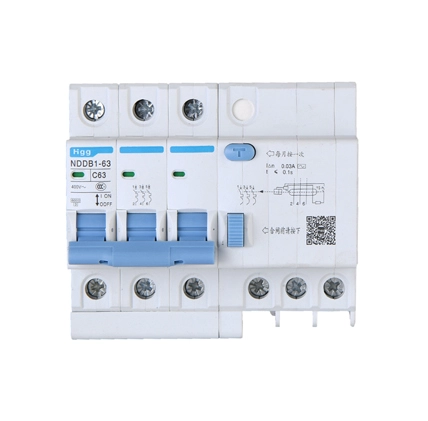
Related Circuit Protection Device From Religare