

Selecting the correct DC miniature circuit breaker (DC MCB) is one of the most critical decisions when designing a solar photovoltaic (PV) system. A properly sized DC MCB protects cables, equipment, and personnel from overloads and short circuits while ensuring reliable system operation throughout the project's lifespan.
However, many installers and buyers mistakenly select breakers based only on current ratings without considering voltage levels, pole configurations, breaking capacity, system architecture, and DC-specific requirements.
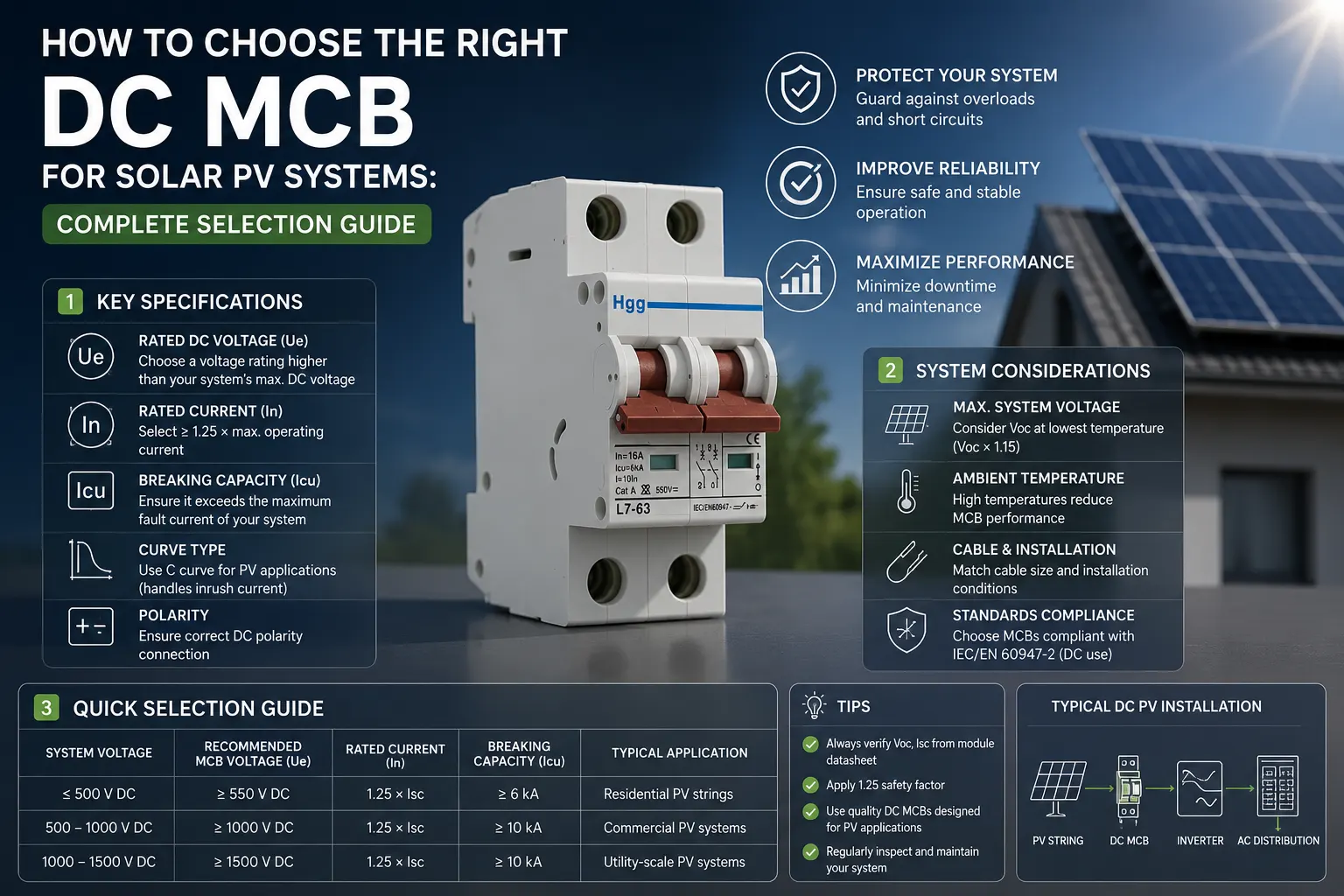
For most residential and commercial solar installations, a properly rated 2 pole dc mcb or 2p dc mcb is the preferred choice because it provides safe isolation and protection for both positive and negative conductors. The ideal DC MCB depends on the PV string voltage, maximum current, applicable standards, and overall system design.
This guide explains how to select the right DC MCB for solar PV applications while avoiding common specification mistakes.
Why Solar PV Systems Require Dedicated DC MCBs
One of the most dangerous misconceptions in solar installations is assuming that AC breakers can be used on DC circuits.
Solar panels continuously generate direct current whenever exposed to sunlight.
Unlike alternating current:
DC current does not naturally cross zero
Electrical arcs are harder to extinguish
Fault currents can persist longer
Contact separation distances must be greater
For this reason, solar systems require breakers specifically designed for DC applications.
A dedicated dc mcb 2 pole incorporates:
Specialized arc extinguishing chambers
Larger contact separation distances
DC-rated switching mechanisms
Enhanced safety under sustained DC loads
Using an AC breaker in a solar DC circuit can create significant fire and safety hazards.
What Does a DC MCB Protect in a Solar System?
DC MCBs are commonly installed to protect:
PV Strings
Protection between solar modules and combiner boxes.
Combiner Boxes
Protection for individual strings and grouped circuits.
Inverter DC Inputs
Protection between PV arrays and inverters.
Battery Energy Storage Systems
Protection for battery banks and energy storage circuits.
DC Distribution Panels
Protection for various DC-powered equipment.
Properly selected breakers reduce the risk of:
Cable overheating
Short-circuit damage
Equipment failure
Maintenance hazards
Understanding Pole Configurations for Solar Applications
Choosing the correct pole configuration is equally important as selecting current and voltage ratings.
Single-Pole DC MCB
A single-pole DC MCB disconnects only one conductor.
Suitable for:
Certain grounded DC systems
Specialized applications
However, it is less common in modern PV installations.
2 Pole DC MCB
A 2 pole dc mcb disconnects both positive and negative conductors simultaneously.
Benefits include:
Complete circuit isolation
Improved maintenance safety
Enhanced fault protection
Compliance with many solar installation standards
For most solar PV systems, a 2p dc mcb is considered best practice.
Step 1: Determine the Maximum System Voltage
The first specification to verify is the maximum DC voltage.
Typical solar system voltages include:
| Application | Typical DC Voltage |
Residential Solar | 600V DC |
Commercial Solar | 1000V DC |
Utility Scale Solar | 1500V DC |
The MCB voltage rating must exceed the highest possible open-circuit voltage (Voc) of the PV string.
For example:
If the maximum string voltage is:
850V DC
The selected breaker should be rated for:
1000V DC or higher
Never choose a breaker with a voltage rating lower than the system's maximum voltage.
Step 2: Calculate Maximum String Current
Current rating selection is another critical factor.
The breaker must carry normal operating current without nuisance tripping while still providing fault protection.
A common industry approach is:
MCB Rating ≥ 1.25 × Maximum Operating Current
Example:
| Parameter | Value |
PV String Current | 12A |
Safety Factor | 1.25 |
Recommended MCB | 16A |
Common DC MCB current ratings include:
6A
10A
16A
20A
25A
32A
40A
63A
Step 3: Verify Breaking Capacity
Breaking capacity refers to the maximum fault current the breaker can safely interrupt.
Typical ratings include:
| Breaking Capacity | Application |
6kA | Residential |
10kA | Commercial |
15kA+ | Industrial |
For larger PV installations and battery storage systems, higher breaking capacities are often required.
Always verify the maximum prospective short-circuit current before selection.
Step 4: Select the Correct Pole Configuration
For most solar systems, a dc mcb 2 pole is recommended.
Reasons include:
Simultaneous disconnection of both conductors
Improved technician safety
Better compliance with modern installation standards
Easier maintenance procedures
Many installers searching for:
2 pole dc mcb
2p dc mcb
are specifically looking for products that provide complete PV string isolation.
Step 5: Consider Environmental Conditions
Solar equipment often operates in challenging environments.
Factors affecting breaker performance include:
High Ambient Temperatures
PV combiner boxes frequently experience elevated temperatures.
Humidity
Outdoor installations require moisture-resistant designs.
UV Exposure
Materials should resist long-term sunlight degradation.
Dust and Corrosion
Industrial and coastal installations require enhanced protection.
Look for products with:
High-quality thermoplastic housings
UV-resistant materials
Long mechanical life
Appropriate enclosure ratings
Understanding DC MCB Curves
Trip curves influence how breakers respond to overload conditions.
Common options include:
| Curve | Typical Trip Range |
B Curve | 3–5 × In |
C Curve | 5–10 × In |
D Curve | 10–20 × In |
Most solar PV systems commonly use:
B Curve
C Curve
depending on inverter and equipment requirements.
C Curve devices are generally preferred in many PV applications due to their tolerance of temporary current fluctuations.
Common Mistakes When Selecting Solar DC MCBs
Choosing AC Breakers Instead of DC Breakers
This remains one of the most dangerous errors in solar installations.
Ignoring Voltage Ratings
Current ratings alone are insufficient.
A breaker must satisfy both:
Voltage rating
Current rating
Undersized Breaking Capacity
Fault currents may exceed the breaker's interruption capability.
Using Single-Pole Protection Where Full Isolation Is Required
Many modern PV systems benefit from a 2 pole dc mcb configuration.
Selecting Based Solely on Price
Low-cost breakers may:
Lack certification
Use inferior arc chambers
Deliver inconsistent tripping performance
Long-term reliability often outweighs minor upfront savings.
What About "2 Phase MCB" and "MCB 2 Phase" Products?
Search terms such as:
2 phase mcb
two phase mcb
mcb 2 phase
often create confusion.
In modern electrical terminology, these terms are commonly used by buyers to describe a two-pole breaker rather than a true two-phase electrical system.
In solar applications, users searching for a two phase mcb are typically seeking a breaker capable of disconnecting both DC conductors simultaneously.
In most cases, a properly rated 2p dc mcb is the correct solution.
Residential vs. Commercial Solar DC MCB Selection
| Feature | Residential Solar | Commercial Solar |
Voltage | Up to 600V DC | Up to 1000V DC |
Current | Lower | Higher |
Breaking Capacity | 6kA–10kA | 10kA–15kA+ |
Pole Configuration | 2P Recommended | 2P Required in Most Cases |
Environmental Demands | Moderate | Higher |
Commercial projects typically require more stringent specifications and certifications.
Questions to Ask Before Purchasing a DC MCB
Before selecting a breaker, verify:
What Is the Maximum System Voltage?
600V? 1000V? 1500V?
What Is the Maximum String Current?
Use the appropriate design safety factors.
Is Full Isolation Required?
If yes, choose a dc mcb 2 pole configuration.
What Is the Required Breaking Capacity?
Match it to calculated fault current levels.
Does the Product Meet Relevant Standards?
Look for compliance with:
IEC 60947-2
IEC 60898
UL standards where applicable
Frequently Asked Questions
Why can't I use an AC MCB in a solar PV system?
AC breakers are not designed to interrupt sustained DC arcs safely. Solar systems require dedicated DC-rated devices.
Is a 2 pole DC MCB necessary for solar systems?
For most modern PV installations, a 2 pole dc mcb provides safer isolation and improved maintenance protection.
What is the difference between a 2P DC MCB and a 2 phase MCB?
In many markets, terms such as 2 phase mcb, two phase mcb, and mcb 2 phase are used informally to describe a two-pole breaker. For solar applications, the correct product is generally a 2p dc mcb.
How do I choose the correct current rating?
A common approach is to select a breaker rated at approximately 125% of the maximum operating current.
Which is more important: voltage rating or current rating?
Both are equally important. A breaker must safely handle the system's maximum voltage and current simultaneously.
Final Thoughts
Choosing the right DC MCB for a solar PV system involves much more than matching an ampere rating. System voltage, breaking capacity, pole configuration, environmental conditions, and compliance requirements all play critical roles in long-term safety and performance.
For most modern solar installations, a properly rated 2 pole dc mcb, dc mcb 2 pole, or 2p dc mcb provides the safest and most practical solution by enabling complete circuit isolation and reliable DC fault protection. By evaluating the full operating conditions of the PV system before purchasing, installers and project owners can achieve greater reliability, improved safety, and lower lifetime maintenance costs.
Related Circuit Protection Device From Religare