

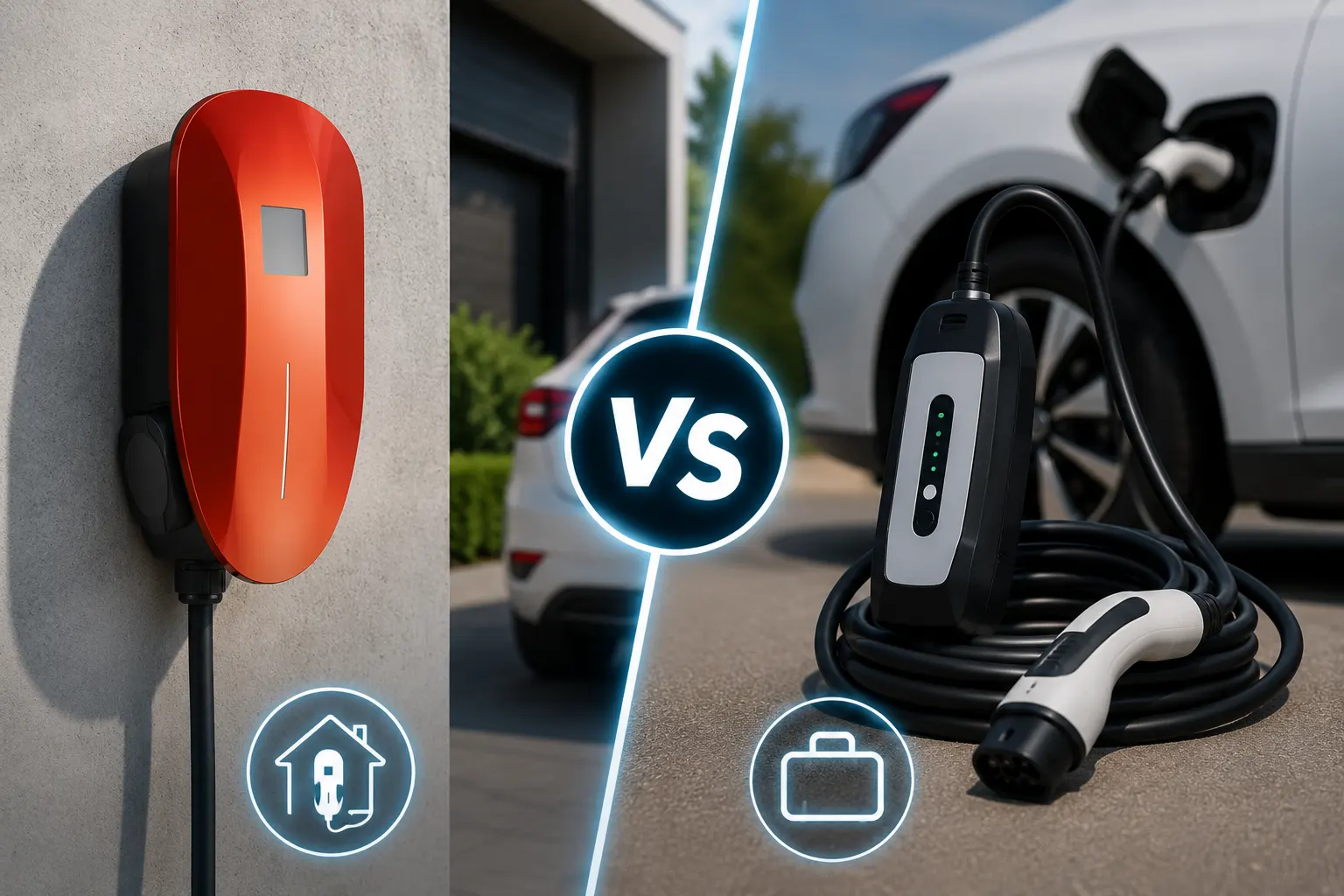
A wallbox 3.7 kW Type 2 charger is the better choice for users who prioritize safety, stability, and long-term residential or commercial use. A portable 3.7 kW car charger is more suitable for flexibility, temporary charging, or travel scenarios. The right option depends on installation conditions, usage frequency, and electrical infrastructure.
Understanding the Two Options
What Is a Wallbox 3.7 kW Type 2 Charger?
A wallbox 3.7 kW Type 2 charger is a fixed, wall-mounted EV charging solution designed for single-phase power systems. It is commonly installed in homes, parking garages, and commercial facilities.
Key characteristics:
Dedicated circuit connection with proper protection devices
Type 2 connector compliant with European standards
Stable 16A output for consistent charging performance
Integration with safety components such as MCB, RCD, or RCBO
What Is a Portable 3.7 kW Car Charger?
A portable 3.7 kW car charger is a plug-and-play charging device that connects to a standard socket (e.g., Schuko or industrial plug).
Key characteristics:
No fixed installation required
Lightweight and easy to transport
Typically includes basic protection features
Charging performance depends on socket quality and wiring
Wallbox 3.7 kW vs Portable Charger: Key Differences
| Feature | Wallbox 3.7 kW Type 2 | Portable 3.7 kW Car Charger |
Installation | Fixed, professional installation required | Plug-and-play |
Safety | High (dedicated circuit + protection devices) | Moderate (depends on socket condition) |
Charging Stability | Consistent output | May fluctuate |
Convenience | Always ready, no setup needed | Flexible but requires setup each time |
Mobility | Not portable | Fully portable |
Application | Home, apartment, commercial use | Travel, backup charging |
Is a 3.7 kW Charger Fast Enough for Daily Use?
A 3.7 kW charger delivers approximately 15–25 km of range per hour, depending on the vehicle.
For:
Plug-in hybrid vehicles (PHEVs): Fully sufficient
Daily commuting EV users: Adequate for overnight charging
High-mileage users: May require faster options (e.g., 7 kW or above)
In practical terms, a wallbox 3.7 kW Type 2 setup provides predictable overnight charging, which is critical for routine use.
Which Option Is Safer for EV Charging?
A wallbox solution is significantly safer due to its integration with electrical protection systems.
Why Wallbox Is Safer
Dedicated circuit reduces overload risk
Compatible with MCB (Miniature Circuit Breaker) for overcurrent protection
Supports RCD/RCBO for leakage protection
Stable grounding and cable management
Risks of Portable Chargers
Socket overheating due to prolonged high current
Inconsistent wiring quality in residential outlets
Limited protection compared to fixed installations
From an electrical engineering perspective, continuous 16A loads (3.7 kW) are better handled by a dedicated circuit rather than standard sockets.
Do You Need Professional Installation for a Wallbox?
Yes, and it is strongly recommended.
A typical installation includes:
Proper cable sizing (usually 2.5–6 mm² depending on distance)
Installation of a 2-pole MCB (16A or 20A)
Residual current protection (Type A or Type B RCD depending on charger design)
Grounding verification
This ensures compliance with IEC standards and long-term operational safety.
Can You Use a Portable EV Charger Every Day?
It is possible, but not always advisable.
Daily use of a portable charger may lead to:
Increased wear on sockets
Heat buildup in connectors
Reduced reliability over time
Portable chargers are best suited for:
Emergency charging
Temporary setups
Travel scenarios
For consistent daily charging, a wallbox 3.7 kW Type 2 system provides better durability and safety.
What Are the Installation Requirements for a 3.7 kW Wallbox?
Typical requirements include:
Power supply: Single-phase (230V)
Current rating: 16A circuit
Protection devices:
MCB (overcurrent protection)
RCD or RCBO (leakage protection)
Dedicated wiring: Independent circuit from distribution board
For manufacturers and suppliers, offering integrated protection solutions alongside chargers significantly improves system reliability and customer confidence.
Which Is More Cost-Effective in the Long Run?
While a portable charger has a lower upfront cost, a wallbox system often delivers better long-term value.
Wallbox Advantages
Lower maintenance risk
Reduced electrical hazards
Higher property value (for residential installations)
Better user experience
Portable Charger Considerations
Lower initial investment
Potential hidden costs (socket upgrades, replacements, inefficiency)
From a lifecycle perspective, the wallbox solution is typically more economical for frequent users.
How Do You Choose Between Wallbox and Portable Charging?
Choose a wallbox 3.7 kW Type 2 charger if:
You charge daily at home or work
You require high safety and compliance
You want a long-term solution
Choose a portable 3.7 kW car charger if:
You need flexibility for multiple locations
You travel frequently
You require a backup charging option
Conclusion
A wallbox 3.7 kW Type 2 charger provides a stable, safe, and professional charging solution, particularly for fixed residential or commercial environments. Portable chargers remain valuable for flexibility but are not ideal as a primary long-term charging method.
For manufacturers, distributors, and project contractors, integrating EV charging solutions with proper circuit protection devices—such as MCBs and RCDs—ensures compliance, enhances safety, and strengthens market competitiveness.
Related Circuit Protection Device From Religare