

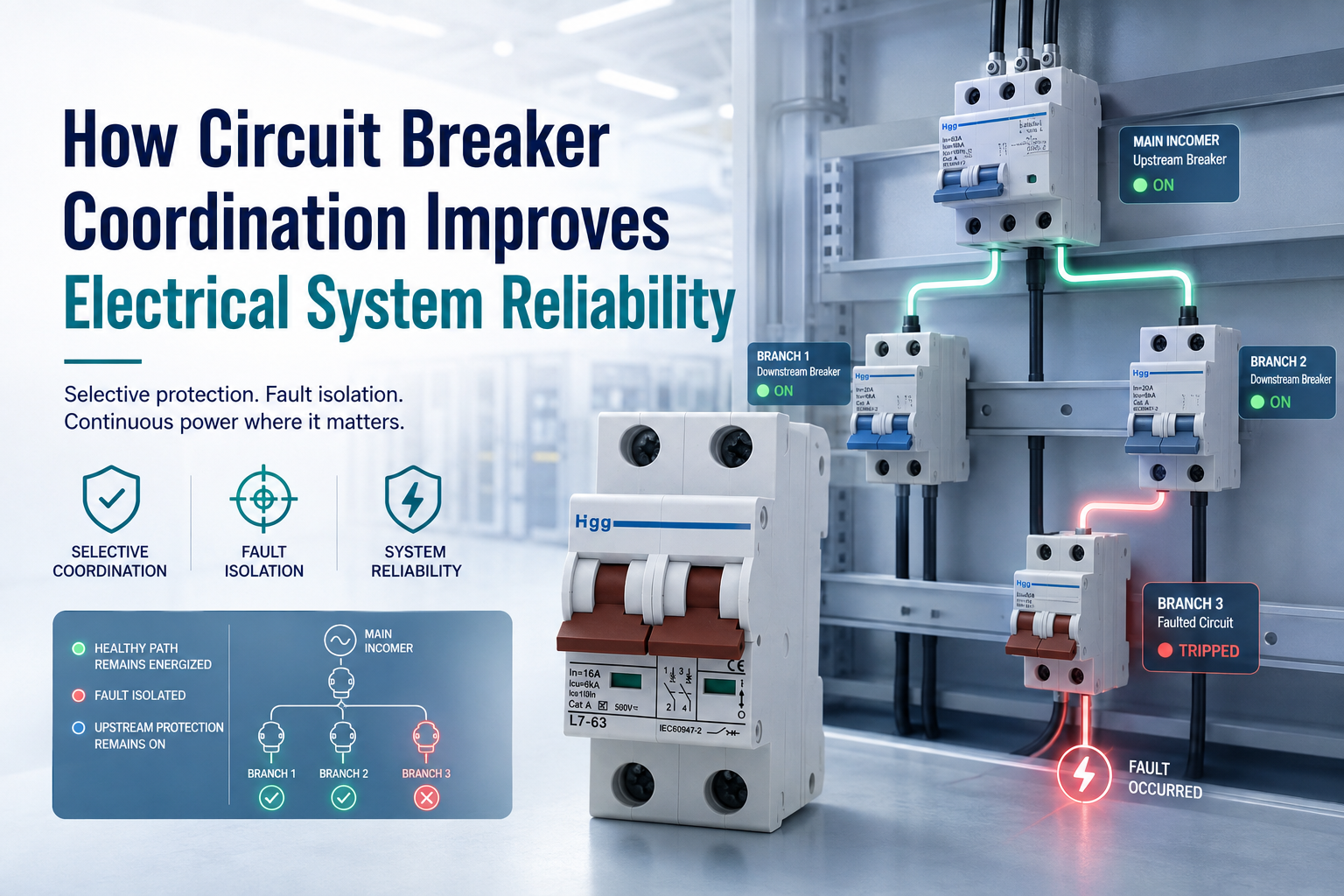
Circuit breaker coordination improves electrical system reliability by ensuring that the protective device closest to a fault operates first, while upstream breakers remain energized for unaffected areas. This selective operation minimizes downtime, reduces equipment damage, and maintains continuity of power in industrial, commercial, and critical electrical installations.
A properly coordinated protection system allows circuit protection equipment to respond accurately under overloads, short circuits, and abnormal operating conditions. Instead of shutting down an entire electrical network, coordinated breakers isolate only the faulted section, improving safety, operational efficiency, and system availability.
What Is Circuit Breaker Coordination and Why Is It Important?
Circuit breaker coordination is the process of adjusting and selecting protective devices so they operate in a planned sequence during electrical faults. The goal is to achieve selective coordination, where the breaker nearest to the fault trips first, while upstream protection devices act as backup protection only when necessary.
In modern power distribution systems, multiple protective devices work together, including molded case circuit breakers (MCCBs), miniature circuit breakers (MCBs), air circuit breakers (ACBs), electronic trip units, and other electronic circuit protection devices. Without proper coordination, multiple breakers may trip simultaneously, causing unnecessary outages and increasing maintenance costs.
Effective breaker coordination is especially important in:
Manufacturing facilities with continuous production requirements
Data centers requiring high power availability
Commercial buildings with complex distribution networks
Renewable energy systems and industrial control applications
Critical infrastructure such as hospitals and transportation systems
How Does Circuit Breaker Coordination Improve Electrical System Reliability?
Circuit breaker coordination improves reliability through several key mechanisms:
1. Minimizes Unnecessary Power Interruptions
The primary benefit of coordination is fault isolation. When a short circuit occurs, only the breaker closest to the fault disconnects the affected circuit. Other areas continue operating normally.
For example, if a motor branch circuit experiences a fault, a properly coordinated system allows the branch breaker to trip while maintaining power to lighting, control systems, and other connected loads.
This approach significantly improves system uptime and prevents small electrical faults from becoming large-scale shutdowns.
2. Reduces Equipment Damage During Fault Conditions
Electrical faults can generate extremely high currents that create thermal and mechanical stress on cables, switchgear, and connected equipment.
Coordinated circuit protection equipment ensures that protective devices respond within the correct time-current range. Faster fault clearing reduces:
Heat buildup in conductors
Arc flash energy exposure
Mechanical stress on electrical components
Risk of permanent equipment failure
For industrial users, this means longer equipment lifespan and lower replacement costs.
3. Enhances Safety for Maintenance Personnel
Poorly coordinated protection systems may cause upstream breakers to trip unexpectedly, leaving large sections of a facility without power and increasing troubleshooting risks.
A coordinated system provides predictable fault responses, helping maintenance teams identify the fault location quickly and restore operation safely.
Advanced electronic circuit protection devices with adjustable trip settings further improve safety by allowing engineers to optimize protection levels according to actual operating conditions.
What Are the Main Types of Circuit Breaker Coordination?
Circuit breaker coordination typically includes several protection strategies:
Selective Coordination
Selective coordination ensures that only the protective device closest to the fault operates. This is the preferred method for systems where continuous power is essential.
Time Coordination
Time coordination uses different trip delays between upstream and downstream breakers. The downstream breaker operates faster, while upstream breakers provide backup protection.
Current Coordination
Current coordination uses different current ratings and trip characteristics to ensure downstream breakers respond first under fault conditions.
Energy Coordination
Energy-based coordination considers the let-through energy of breakers during faults. It helps limit damage by reducing the amount of energy reaching downstream equipment.
How Is Circuit Breaker Coordination Achieved?
Achieving effective coordination requires careful engineering analysis rather than simply selecting breakers with different ratings.
Key steps include:
1. Analyze the Electrical Distribution System
Engineers first evaluate:
System voltage levels
Available short-circuit current
Load characteristics
Transformer ratings
Cable sizes
Protective device locations
This information establishes the operating conditions for the protection system.
2. Select Compatible Protective Devices
Circuit breakers must be selected based on:
Interrupting capacity
Trip characteristics
Current ratings
Coordination tables
Manufacturer performance curves
Using compatible protection products helps ensure reliable operation.
3. Perform Time-Current Curve Analysis
Time-current characteristic (TCC) curves are used to compare breaker operating times under different fault currents.
Engineers adjust settings so that:
Downstream devices trip faster
Upstream devices provide backup protection
Protective zones remain coordinated
4. Verify Performance Through Testing
After installation, coordination studies and field testing confirm that the protection system performs as designed.
Regular verification is recommended when electrical systems are expanded or equipment settings are modified.
What Happens If Circuit Breakers Are Not Properly Coordinated?
Without proper coordination, electrical systems may experience:
Multiple breakers tripping during a single fault
Larger areas losing power unnecessarily
Longer recovery times
Increased equipment damage
Higher maintenance expenses
For industrial operations, poor coordination can lead to production interruptions and significant financial losses.
How Do Electronic Circuit Protection Devices Support Modern Power Systems?
Modern electrical systems increasingly rely on intelligent protection technologies. Electronic circuit protection devices provide advanced monitoring, adjustable protection settings, and improved coordination capabilities.
Compared with traditional thermal-magnetic protection, electronic protection solutions can offer:
More accurate fault detection
Adjustable overload and short-circuit settings
Communication capabilities for smart energy systems
Real-time operational monitoring
Improved coordination between multiple protection levels
These features make them valuable in complex applications where reliability and operational continuity are critical.
What Factors Should Be Considered When Designing a Coordinated Protection System?
A reliable coordination strategy should consider:
System architecture and distribution hierarchy
Fault current levels
Equipment protection requirements
Load sensitivity
Future system expansion
Applicable electrical standards
Manufacturer coordination data
Professional engineering evaluation is essential because every electrical installation has different operating conditions.
Conclusion
Circuit breaker coordination is a fundamental element of reliable electrical system design. By ensuring protective devices operate in the correct sequence, coordinated systems reduce unnecessary outages, protect valuable equipment, and improve operational safety.
For modern power networks, combining well-designed circuit protection equipment with advanced electronic circuit protection devices enables higher reliability, faster fault response, and better control over electrical performance. Proper coordination is not only a protection strategy—it is a long-term investment in system stability and operational efficiency.
FAQs
1. What is the main purpose of circuit breaker coordination?
The main purpose is to ensure that only the breaker closest to a fault trips, keeping other parts of the electrical system operating.
2. Why is selective coordination important?
Selective coordination reduces unnecessary power interruptions and improves system reliability, especially in critical facilities.
3. How often should circuit breaker coordination studies be performed?
Coordination studies should be reviewed when electrical systems are modified, expanded, or when major equipment is replaced.
4. Can electronic circuit breakers improve coordination?
Yes. Electronic circuit breakers provide adjustable trip settings and advanced monitoring features that support more precise coordination.
5. What industries require coordinated circuit protection systems?
Industries such as manufacturing, data centers, healthcare, energy, and commercial infrastructure commonly require coordinated protection systems.
Related Circuit Protection Device From Religare